
Ours used to be the freezer of shame. Every time I opened it, something fell out. I had no idea what was in there, and I was fairly sure one of the bags at the back had been there since we moved in. If that sounds familiar, upright freezer storage is something you can genuinely sort out in an afternoon – and the difference it makes to daily life is completely disproportionate to the effort it takes.
I got our tall upright freestanding freezer a couple of years ago. It lives in our utility room and gets used every single day. I batch cook a fair amount, we have three kids who all eat different things at different times (the joys), and the fridge freezer was permanently rammed. So we got a second one. But for about the first six months, it was just as chaotic as the original – just bigger chaos.
What changed things was realising that most of the organisation advice out there is either American, talks about chest freezers, or is so generic as to be basically useless. Zones! Label things! Use containers! Yes, thank you, but how exactly? So this is what I actually did, what containers I actually use, and what I wish I had known sooner.
The Thing Most People Get Wrong First
The mistake almost everyone makes – myself included – is organising by food type. Meat shelf. Veg shelf. Bread shelf. It seems obvious, but it is actually the least helpful way to think about it.
Think about how you actually use the freezer. You do not open it thinking “I need something from the meat category.” You open it thinking “what can I cook for dinner tonight” or “I need something for tomorrow’s packed lunches.” The most useful freezer organisation maps to those real-life moments, not to a taxonomy of food groups.
Once I switched to organising by use case rather than food type, everything got easier. More on exactly what that looks like in a minute, but first – you need to start with a clean slate.
The Bit You Need to Do Before Anything Else
Empty it out completely.
I know. It is horrible. Do it on a cold day, pile everything into cardboard boxes on the back step, and work quickly. While you have it empty, if there is any ice build-up at all, defrost it. A freezer that is iced up is less efficient and has less usable space. A hairdryer, some old towels, and about 40 minutes. Not glamorous, but worth it.
As you go through everything, be ruthless. If you cannot identify it, it goes. If it has been in there more than six months and you have genuinely forgotten about it, it probably goes. If it is freezer-burned beyond saving, it goes. This is not the time to be optimistic about what you might one day do with a single chicken breast from 2023.
What you are left with is stuff that has earned its place back in the freezer. Now you can actually think about where it goes.

How to Zone an Upright Freezer Properly
Here is the system that works in our house. Yours might need tweaking depending on what you actually cook and eat, but this is a good starting point.
Top shelf: ready-to-go food. This is where batch cooking lives. Tubs of soup, portions of bolognese, curry, shepherd’s pie, leftover casserole. Anything that just needs reheating. This shelf is the answer to the “what is for dinner” question at 5pm, and it is genuinely one of the most useful things I have ever done for our household routine.
Middle shelf: raw proteins. Chicken portions, mince, sausages, fish fillets, bacon. Everything that needs defrosting before cooking. These are in labelled bags or containers, sorted loosely by type – chicken together, fish together, and so on.
Bottom shelf: vegetables, fruit, and freezer staples. Frozen peas, sweetcorn, edamame, berries for smoothies, spinach, chips. Stuff that either goes straight from frozen into a pan, or is a backup when the fresh stuff runs out. The bottom of the freezer is also the coldest and most stable temperature, which suits raw proteins – some people put meat here for that reason, and that works too. I prefer having the veg here because it is the most chaos-tolerant shelf.
Door shelves: the odds and ends. Ice lollies (the kids), small bags of frozen herbs, a block of butter, a couple of portions of leftover rice. The things that do not belong to a category but need to live somewhere. Do not put anything you care deeply about on the door – it is the warmest part of the freezer because it gets all the temperature fluctuation from opening.
Drawer (if you have one): Bread, crumpets, muffins, pastry. Anything flat and awkward that does not stack well in containers.
The key is that when one of the kids asks what is for tea and I say “have a look in the top shelf,” they can actually find something without having to excavate the entire freezer. That alone is worth it.
What Containers to Actually Use (UK Edition)
Most of the organisation content you will find online recommends products that either are not available in the UK, cost an absolute fortune, or both. Here is what genuinely works and where to get it.
For batch cooking portions: Sistema clip containers are brilliant and you can get them in Tesco, Waitrose, and Sainsbury’s. The square and rectangular ones stack properly. I use two sizes – a medium-ish one (around 600ml) for single portions and a larger one for family portions. Lock and Lock rectangular boxes are also very good and hold up well in the cold.
Stick to one brand and two sizes if you can, so they actually stack. A mishmash of random containers from different brands mostly just topples over.
For raw meat and veg: Zip-lock freezer bags. Proper freezer ones, not sandwich bags – they are thicker and less likely to get freezer burn. Press the air out before sealing.
Then do this, because it is genuinely a revelation if you have not tried it: freeze things flat. Lay the filled bag on a baking tray, slide it into the freezer, and leave it until solid. Once frozen flat, you can stand the bags upright like files in a drawer. They take up a fraction of the space that containers do, and you can read the labels at a glance.
A shelf done this way with bags of mince, chicken, and fish fillets, all standing upright in a row, is one of the most satisfying things I have done in my kitchen. My husband thought I was being ridiculous until he found exactly what he needed for dinner in about four seconds.
For veg and loose items: Open-top freezer bins or small baskets stop things rolling around and creating chaos. Lakeland does decent freezer organisers. IKEA’s basic storage boxes sometimes work if you check the measurements first. The goal is just to corral loose bags into sections so they do not take over the whole shelf.
What not to bother with: Round containers. They waste corner space and do not stack flat. Very deep containers where things get lost at the bottom. And those stick-on label holders that are supposedly for containers – they fall off within about a week in a cold environment. Write directly on the container with a whiteboard marker, or use masking tape and a Sharpie.

Labelling: Please, Just Do This
I know it feels like faff. It is not faff. It is the thing that stops you thawing something random and then discovering it is the soup you made in October that nobody liked.
Two pieces of information on every label: what it is, and when it went in.
That is all. You do not need a colour-coded system or a spreadsheet (though if you want one, there is a meal planning post here that covers exactly how we do that. Just what and when.
Whiteboard marker on containers – it wipes off easily so you can reuse them. Permanent marker directly on zip-lock bags. Keep a Sharpie in the drawer next to the freezer so there is no excuse.
Most cooked food is best within about three months for quality, though it stays safe much longer at a consistent minus 18 degrees. The date label means you can rotate things – older stuff at the front, newer stuff at the back – and you stop finding things that are technically still food but have been forgotten for two years.
The Door List (This Is the Boring-Sounding One That Makes the Biggest Difference)
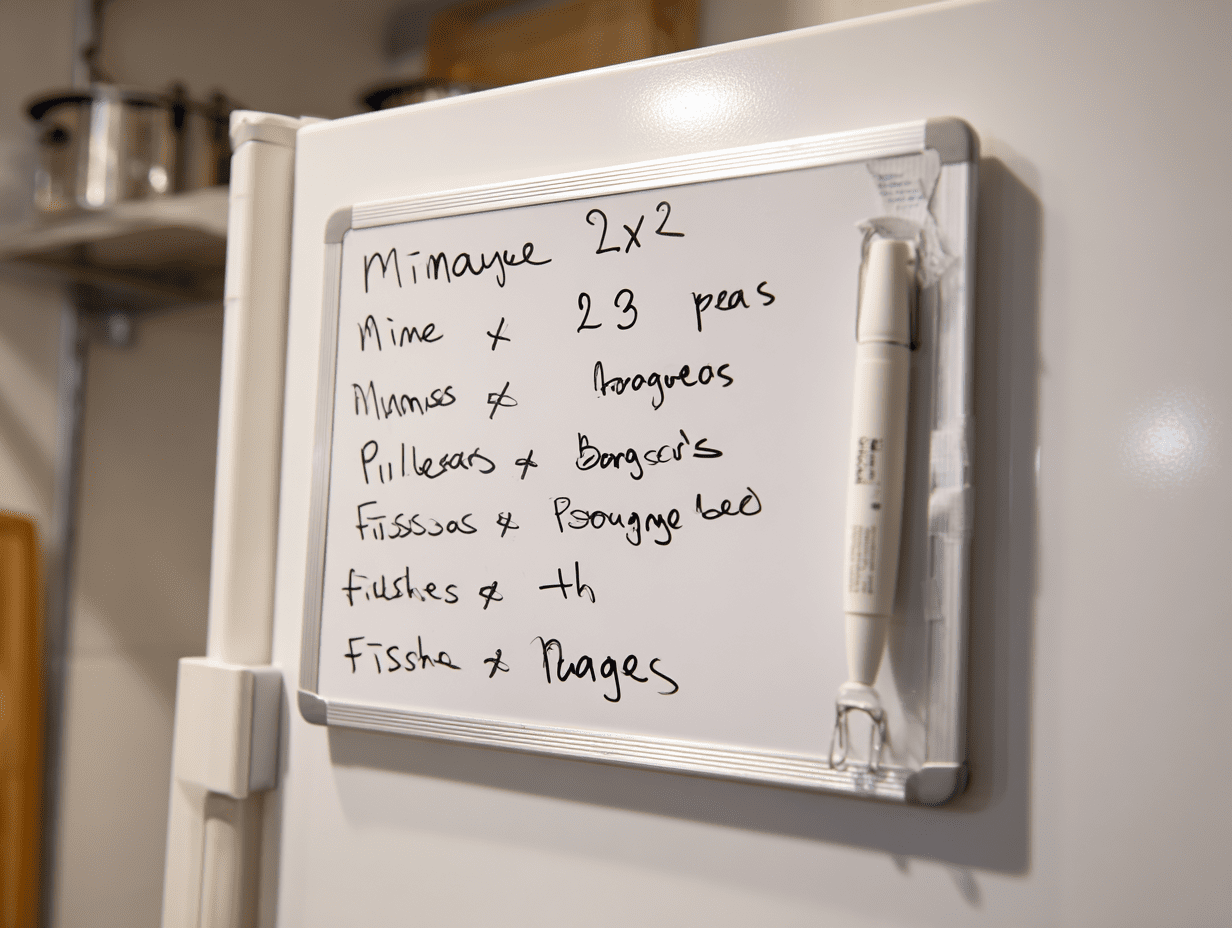
Stick a small whiteboard on the side of your freezer, or hang a notepad from a hook nearby. On it, keep a rough list of what is inside.
When something goes in, add it. When something comes out, cross it off.
The reason this works so well is not really about the list itself – it is that it makes the contents of your freezer visible without opening it. When you are planning the week’s meals, you can see that you have got three portions of curry and some chicken thighs and a bag of mince, and you can plan around that rather than buying more. When you are writing a shopping list, you do not accidentally buy things you already have.
Food waste in our house went down noticeably once I started doing this. Not dramatically, not immediately, but over a few months it became obvious. You stop losing things. You stop duplicating things. You actually use what you have got.
A small whiteboard with a sticky back does the job fine. It does not need to be fancy.
A Few Things Nobody Really Mentions
The back of shelves is a dead zone if you let it be. Anything pushed to the back of a shelf will get forgotten, full stop. Try to keep shelves one row deep wherever possible. If the freezer is too full for that, it is usually a sign you need to eat from it for a couple of weeks before you buy more.
Removing things from their original packaging saves a surprising amount of space. A bag of supermarket chips in its original box takes up twice the space it needs to. Decant into a zip-lock bag and you will be amazed. Ditto those individually wrapped things that come in a big cardboard box – take them out, bag them up, chuck the box.
Temperature matters more than people think. The door is the warmest part, the bottom tends to be the coldest. Raw meat is safest at the bottom (any drips stay contained there and away from other food). Things you use constantly, like frozen veg and bread, can live wherever is most convenient.
If your freezer is in an unheated space like a garage or utility room, check the temperature rating. Some cheaper freezers are not rated for ambient temperatures below a certain point and can behave strangely in very cold UK winters. Most modern ones are fine, but it is worth checking the manual if yours is in a garage and you live somewhere that gets properly cold in January.
You do not need to do this all in one go. If a full freezer audit feels overwhelming, do one shelf at a time over a few weekends. The system will still work even if it takes a month to implement properly.
Things to Freeze That People Often Forget About
Once you have got a proper system, you might find yourself using the freezer more creatively. A few things that are genuinely worth freezing that often get overlooked:
- Bread before it goes off (sliced bread defrosts in minutes at room temperature or can go straight in the toaster)
- Fresh herbs in ice cube trays with a little olive oil – brilliant for cooking
- Leftover tomato puree and coconut milk (freeze in ice cube trays and transfer to a bag)
- Grated cheese – you can use it straight from frozen in most cooked dishes
- Over-ripe bananas, peeled and bagged, for baking
- Cooked rice in portions (cool quickly, freeze, and reheat with a splash of water)
- Stock, in ice cube trays then transferred to a labelled bag
- Leftover wine (yes, really – freeze in ice cube trays for cooking)
- Milk (I have a whole post on this here)
The freezer is a genuinely useful tool once you stop thinking of it as just the place you keep the fish fingers.

FAQs
What are the best containers for an upright freezer in the UK?
Square or rectangular stackable containers with clip or locking lids are the most space-efficient. Sistema, Lock and Lock, and Wham are all decent and widely available in UK supermarkets. For raw meat and vegetables, proper zip-lock freezer bags (frozen flat and stood upright) save significant space. Avoid round containers – they waste corners – and very deep containers where things get lost at the bottom.
How do I stop things getting lost at the back of my upright freezer shelves?
Keep shelves one row deep wherever possible, and use open-top bins or baskets to create defined sections. Freezing things flat in bags and standing them upright means everything is visible from the front. A weekly or fortnightly 5-minute check of what is lurking at the back also helps – it takes almost no time once you are in the habit.
Should I organise my upright freezer by food type or by how I use it?
By how you use it. Grouping “all meat together” sounds logical but means you are hunting through the whole freezer every time you want to plan a meal. Organising by use case – a batch cooking shelf, a raw proteins shelf, a veg and staples shelf – is far more useful in daily life. It also makes it easier to delegate to other people in the household, which is worth a lot.
How long can food stay in an upright freezer?
Food stays safe indefinitely at a consistent minus 18 degrees Celsius, but quality degrades over time. Most cooked meals and soups are best within three months. Raw mince and chicken portions are fine for three to four months. Whole joints and bread can last up to a year. The Food Standards Agency has a good guide to freezing times if you want specifics. The most practical answer is: label everything with a date, use older things first, and if you find something that has been in there for a year, just bin it and move on.
Is it worth getting a separate upright freezer for a family?
For a family that cooks from scratch at all, or shops in bulk, almost certainly yes. The fridge freezer compartment is almost never big enough for real-life use. An upright freestanding freezer gives you enough space to batch cook properly, buy reduced meat and freeze it, and store things without the constant Tetris game. A mid-size upright (around 200 litres) is more than enough for most families.
An organised upright freezer genuinely makes daily life easier. Not in a vague aspirational way, but in a concrete “I can get dinner on the table in 20 minutes because I know exactly what I have got and where it is” way. The setup takes an afternoon. The maintenance is five minutes a week. It is one of those things that seems boring until you have done it and then you cannot believe you lived without it.
See more home organisation posts here
AND more Kitchen organisation posts here!

Becky is the voice behind Life in Velvet, an organised, intentional living blog focused on practical food, calm homes, thoughtful projects, and everyday systems that make real life feel easier. A mum of 3 living in the UK, Becky writes from lived experience, sharing what works, what doesn’t, and the decisions that make family life run more smoothly.
With a background in marketing and content writing, and over a decade of blogging experience, she brings a thoughtful, structured approach to everything from baking and home projects to routines and decision-making. Life in Velvet is where planning meets creativity, with ideas designed for real homes and real life.