AT A GLANCE
- Switching from stacking to vertical storage is the single most impactful change you can make
- UK kitchen cupboards are smaller than American ones, so most advice you find online will not directly translate. Measure before you buy anything.
- Your under-oven drawer (if you have one) is almost certainly your best bakeware storage option, and most people underuse it
- Decluttering comes first, always. You almost certainly own more bakeware than you actually need
- You can solve this for under £20 with products available from UK shops, no DIY required
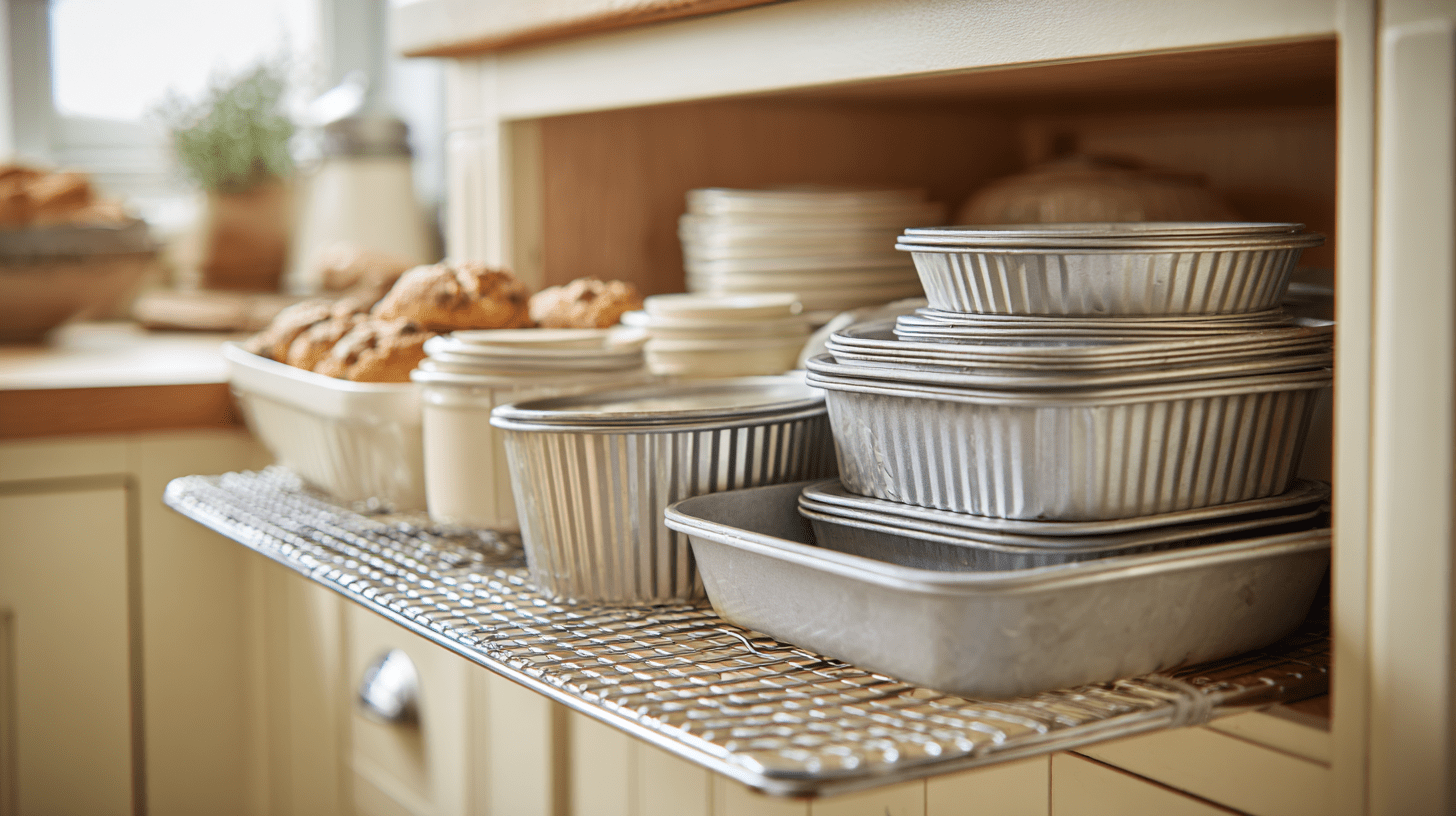
There is a specific kind of low-level kitchen frustration that only baking pan chaos creates. It is not dramatic. Nobody talks about it. But it is there, quietly ruining things, every single time you fancy making a traybake on a Sunday afternoon and end up performing a structural rescue operation inside a cupboard just to retrieve one tin.
That was my kitchen for longer than I would like to admit. Deep lower cupboard to the left of the oven. Baking sheets stacked flat, muffin tin wedged sideways, a 20cm sandwich tin from 2017 somehow at the bottom of everything, my wire cooling rack balanced on top of the whole precarious tower. Every time I opened the door, something fell out. Usually onto my foot. Sometimes onto my youngest’s foot, which went down significantly worse.
I fixed it. Properly. And I want to share exactly how, because the advice I found when I went looking was, without exception, written for American kitchens. American kitchen cupboards. American baking sheet sizes. American shops. Not a terraced house in South East London with a galley kitchen, one deep lower cupboard, and children who also occasionally retrieve their own tins.
Why Baking Pans Are So Awkward to Store
The problem is that bakeware is a completely non-uniform collection of objects. A 20cm round sandwich tin does not nest with a rectangular traybake tin. A flat baking sheet cannot sit alongside a muffin tray. A wire cooling rack cannot stack with anything. Add in a loaf tin, a springform tin, a roasting tray, maybe a pizza tray, and you have a collection of items with almost nothing in common dimensionally.
The instinctive response to all of this is to stack everything flat and hope for the best. This is why bakeware cupboards look the way they do in most kitchens. Stacking feels logical until you need the tin at the bottom, which you always do, and then the whole thing comes apart.
The fix, almost without exception, is vertical storage. Store pans on their edges, separated by dividers, and you can lift any single item out without touching anything else. It is not complicated. But before we get there, there is a more important step.

Step One: Take Everything Out and Actually Reckon With It
Pull every single item out of wherever you currently store your baking pans. Everything. Lay it all on the kitchen floor or worktop and look at what you actually have.
I did this exercise and found: two baking sheets so warped they rocked on a flat surface, a springform tin with a broken clasp that I had been meaning to replace for two years, three small tartlet cases I bought during a phase in 2021 and used once, a petit four tin I cannot explain, and a silicone muffin tray that had inexplicably turned orange from a curry it came near in 2022.
Most of us have significantly more bakeware than we actually use. The collection grows incrementally (a birthday present here, a charity shop bargain there) and because we rarely take everything out at once, we do not realise how much has accumulated.
The rule I use here: if I have not used it in the past twelve months and have no specific upcoming plan that requires it, it goes. Charity shops take bakeware. Facebook Marketplace will find it a home quickly. You do not need to keep things simply because you own them.
What a sensible core UK bakeware collection actually looks like:
One or two flat baking sheets, a roasting tin, one or two 20cm round sandwich tins (two if you bake layered cakes), a 2lb loaf tin, a rectangular traybake tin (23x33cm is the UK standard), a muffin tray if you actually bake muffins, and a wire cooling rack. That is genuinely all most households need.
Everything else (the novelty tins, the mini versions of things you have in standard sizes, the specialist equipment for things you made once) can leave.
Once you have decluttered properly, you will almost certainly find the volume of what remains is far more manageable. This matters a great deal for the next step.
Step Two: Measure Your Space Before Buying Anything
This is the step most people skip, and it is the reason most people end up with organiser products that do not fit.
The inside height of your cupboard or drawer determines almost everything. Most bakeware dividers and vertical storage inserts are designed to stand upright inside a cupboard. If your cupboard shelf height is lower than the organiser’s stated height, it will not fit with the door closed. This sounds obvious. It is also extremely easy to overlook when you are browsing listings online.
What to measure:
Inside height from base to the underside of the shelf above (or the top of the cabinet if it is one undivided space). Inside depth from front to back. Inside width. Write these down before you search for anything.
One important note for UK kitchens specifically: our standard kitchen cupboards tend to run shallower front-to-back than American ones. American kitchen organiser content often features products designed for 24-inch deep cabinets. UK base units are typically 60cm deep (roughly 23.5 inches), which is close but not identical, and the products themselves can vary. Always check the stated product dimensions against your actual measurements, and allow at least 2-3cm of clearance rather than looking for an exact fit.
Step Three: Do Not Overlook Your Under-Oven Drawer
Before you commit to a cupboard solution, I want to talk about the under-oven drawer. It is the most underused bakeware storage space in the average UK kitchen, and it is almost never mentioned in any organising content I have come across.
Many UK fitted kitchens (particularly those built in the last twenty or so years) have a shallow drawer built into the base unit directly beneath the oven. It is often called a warming drawer, though in most standard fitted kitchens it is simply a storage drawer with a low-profile front that matches the kitchen door units.
This drawer is almost perfect for flat bakeware. Baking sheets, flat roasting trays, pizza trays, chopping boards (items that are wide and flat and that create problems in normal cupboards because of their size) slide in and out of this drawer effortlessly. Because the drawer is shallow, you do not have items stacked on top of each other. You can see everything at once and pull out exactly what you need.
If your kitchen has one of these drawers and you are currently using it to store oven gloves, takeaway menus, or nothing at all: please reclaim it for your flat baking sheets. It will change things more than almost any organiser product will.
One important note: if you have a gas hob and an under-oven drawer, check whether heat is an issue during cooking before storing anything plastic-handled in there. For electric ovens, this is not usually a concern.

Step Four: Choose the Right Storage Solution for the Space You Have
Once you have decluttered and measured, you can think about storage solutions. Here is what actually works, with honest assessments of each.
A Vertical Bakeware Divider (Best for Most People)
This is what I use and what I recommend first to anyone whose kitchen has a standard lower cupboard. A bakeware divider or rack sits inside your existing cupboard and creates individual vertical slots. You stand each tin on its edge, slide it into a slot, and can remove any single one without disturbing anything else. It is genuinely transformative.
What to look for when buying one:
Adjustable dividers so you can customise the slot widths to suit your actual collection. A 20cm round tin needs a different slot width to a flat baking sheet. A solid base rather than wire-only construction. Wire-only dividers bend under the weight of heavier tins over time. Non-slip feet so the whole thing does not slide around inside the cupboard every time you open the door.
In the UK, you can find adjustable bakeware racks in the £15-£30 range from several places. Lakeland tends to stock good quality versions. Amazon UK has a range, with the SONGMICS adjustable bakeware organiser being a popular and well-reviewed option. Dunelm sometimes stocks similar products in their kitchen storage section.
Always read the stated product dimensions carefully and compare them to your written-down cupboard measurements before purchasing.
Tension Rods in a Drawer (Brilliant for Flat Items)
If you have a deep kitchen drawer (including the under-oven drawer mentioned above) tension rods are a cheap and clever solution. Place several tension rods vertically across the drawer at intervals and they function as dividers between which you can slot flat baking sheets, trays, and chopping boards. Pull out exactly what you need, slide it back in. Done.
This works particularly well for items that are wide and flat but do not stand up on their own easily. It does not work as well for deep or irregularly shaped items like muffin trays or springform cake tins.
Small tension rods (also sold as spring rods or cabinet tension rods) are available from IKEA, Amazon UK, and most discount homeware shops. Buy a few different lengths to be safe. You want them to fit snugly across your drawer without being an exact fit.
A Metal File Organiser (Budget Option That Genuinely Works)
A sturdy metal file organiser, the kind designed to hold paperwork on a desk, functions well as a bakeware divider for flat items. The slots are usually a fixed width and the organiser does not adjust, which is the main limitation. But for a standard collection of flat baking sheets and a couple of round cake tins, it works perfectly well and costs very little.
IKEA sells metal magazine files (the KVISSLE range) that work for this. Amazon UK has plenty of options. For anyone wanting to try the system before committing more money, this is a good starting point.
A Note on Rented Kitchens
A significant number of UK households are renting, and if that is you, your options are more constrained. Wall-mounted pegboards are off the table if your tenancy agreement does not allow fixings. Built-in dividers are not an option. The good news is that freestanding solutions (bakeware racks, tension rods in drawers, and file organisers) all work perfectly well in rented kitchens because they sit inside existing cupboards and drawers without any modification. Nothing gets attached to walls or cabinets. Everything lifts out if you move.
If you are in a rental with particularly difficult kitchen storage, a small freestanding trolley or baker’s rack kept to one side of the kitchen can act as dedicated bakeware storage and moves with you when you leave.
Pegboard (For Those With a Spare Wall)
If you have a kitchen wall that is not in use and you own your home, a pegboard system can be a genuinely practical and visually pleasing way to store bakeware. Pans hang from hooks, are immediately visible, and the whole system frees up cupboard space for other things.
IKEA’s SKADIS pegboard system is the most straightforward UK option. Reasonably priced, widely available, and the accessories are interchangeable if you want to reconfigure it later. The honest caveat is that this is a project rather than a quick fix, and it only works if you have a suitable wall in a kitchen where exposed storage makes sense aesthetically.
Which Solution Suits Your Situation?
| Situation | Best Solution | Rough Cost | UK Stockists |
|---|---|---|---|
| Standard lower cupboard, mixed tin types | Adjustable bakeware rack | £15-£30 | Lakeland, Amazon UK, Dunelm |
| Deep drawer or under-oven drawer | Tension rods | £5-£10 | IKEA, Amazon UK |
| Tight budget, mainly flat trays | Metal file organiser | £5-£12 | IKEA, Amazon UK |
| Rental kitchen (no fixings) | Any of the above | £5-£30 | As above |
| Wall space available, own your home | Pegboard with hooks | £30-£60 | IKEA, Amazon UK |
| Large collection, bigger kitchen | Combination of rack and tension rods | £25-£40 | Mix of the above |
Most kitchens end up using two approaches in combination: a bakeware rack in the main cupboard for cake tins and muffin trays, and tension rods or an under-oven drawer for the flat items. The table above is a starting point, not a rule.
Step Five: The Thing Nobody Mentions About Protecting Your Non-Stick Surfaces
Vertical storage solves the accessibility problem but does not automatically solve the scratching problem. Non-stick baking tins and trays can be damaged when metal edges contact the non-stick coating repeatedly, even in a vertical storage system where they are not stacked flat.
The fix is simple. Between any non-stick items that will regularly brush against each other, place a small square of kitchen paper, a thin cloth, or a silicone mat. Some people use cheap felt furniture pads, which work equally well. This is particularly worth doing with non-stick baking sheets and non-stick muffin trays, as the coatings on these are more vulnerable than on standard cake tins.
You can also buy thin foam pan protectors specifically for this purpose, though kitchen paper does the same job at no cost.
Step Six: Where Does the Cooling Rack Actually Go?
The cooling rack is the bane of bakeware storage everywhere. It is almost never mentioned in organising content, presumably because nobody has a clean answer, but it causes disproportionate chaos in most kitchens because it does not fit neatly into any category.
In my experience, the best options are:
Store it vertically alongside your baking sheets, using the same tension rod or file organiser system. A standard wire cooling rack will slot in between two tension rods in a drawer without any trouble.
Hang it on the inside of a cupboard door using a couple of over-door hooks if your door has clearance. This works particularly well in deeper kitchen units.
If you bake very regularly, keep it out on the worktop permanently rather than fighting it back into a cupboard every time. A cooling rack that is in frequent use does not need to be stored at all. It just needs a designated spot on the worktop where it lives.
What definitely does not work is balancing it on top of everything else in the pan cupboard. That is where I started, and it is where things fall from.

Step Seven: The Habits That Actually Keep It Organised
Any system is only as good as the habits around it. Here is what I have found to be true after actually living with this.
Return things to their slot immediately after washing. Not after drying. Not later. Bakeware that sits beside the sink waiting to be put away will stay there until someone needs the counter space and shoves it back in the cupboard without looking. The slot system only works if things go back into their slots.
Label the slots if other people use the kitchen. I resisted this for a while because it felt over-earnest, but a small sticky label or a piece of masking tape on the front of each slot (“flat trays,” “muffin tin,” “loaf tin”) removes the need for anyone to make a decision about where things go. My children can now put bakeware away correctly. This is not because they are especially organised. It is because the label removes the need to think about it.
Declutter again every six months. Bakeware accumulates. Do a quick review in January and July and remove anything that has not been used. Keeping the volume in check is what stops the system from gradually reverting to chaos.
A Genuine Note on UK Kitchens Specifically
Most bakeware organisation content online is produced in America, for American kitchens. American kitchens are larger. American base cabinets are typically 24 inches deep (about 61cm) where UK base units tend to be 60cm, and there is often significantly more overall cupboard space. American half-sheet pans (33x46cm) are larger than the baking sheets most UK home ovens can take, because American ovens tend to be bigger. American “builder-grade” cabinet dimensions do not map to UK standard kitchen dimensions.
What this means practically: before you follow any storage tutorial or buy any product you found through an American blog or YouTube channel, check the dimensions. The solution concept is usually the same (vertical storage, dividers, declutter first) but the specific product, the specific measurements, and the specific spatial reality will likely be different.
The other UK-specific thing worth knowing: if you bake from UK recipes, your standard bakeware sizes (20cm round tins, 2lb loaf tins, 30x20cm traybake tins) are genuinely smaller than American equivalents, which actually makes things slightly easier. Fewer outsize items to accommodate.
Frequently Asked Questions
What is the best way to organise baking pans in a small UK kitchen? The most effective approach is vertical storage combined with ruthless decluttering. Use an adjustable bakeware rack in your main cupboard to store tins on their edges, and use tension rods in a deep drawer (or your under-oven drawer if you have one) for flat items like baking sheets. Before buying anything, measure your available space precisely. UK kitchen cupboards are smaller than American ones, and product dimensions matter.
Should I store baking tins in a cupboard or a drawer? Both work well, but for different items. Flat baking sheets, trays, and pizza pans are best stored in a deep drawer (particularly the shallow drawer beneath a fitted oven, if your kitchen has one) using tension rods as dividers. Cake tins, muffin trays, loaf tins, and springform tins work better in a cupboard with a vertical bakeware rack. Most kitchens benefit from using both solutions in combination.
How do I stop baking tins from scratching each other? Vertical storage means tins are not stacked directly on top of each other, which removes most of the scratching risk. For non-stick items specifically, place a small square of kitchen paper, a felt furniture pad, or a thin foam sheet between any surfaces that regularly touch each other in the storage system. This is particularly worth doing for non-stick baking sheets and muffin trays, where the coating is most vulnerable.
What can I use instead of a bakeware rack? A sturdy metal file organiser or magazine holder works well for flat baking sheets. Tension rods in a drawer create effective dividers for flat items. A wooden wine rack can hold round cake tins upright surprisingly well. For a completely free solution, placing a baking sheet vertically against the back of a cupboard and using existing items as makeshift barriers works as a temporary fix while you work out what you actually need.
How many baking tins do I actually need? For most UK households, the core collection is: one or two flat baking sheets, one roasting tin, one or two 20cm round sandwich tins, a 2lb loaf tin, a rectangular traybake tin (23x33cm covers most UK recipes), and a muffin tray if you actually use one. A wire cooling rack. That is it. Everything beyond that needs to earn its place through genuine regular use.
How do I organise baking pans in a rented kitchen? Freestanding solutions (bakeware racks, tension rods in drawers, and file organisers) all work perfectly in rented kitchens because they sit inside existing cupboards without any fixings or modifications. Avoid wall-mounted pegboards unless your tenancy agreement explicitly allows fixings. If your kitchen storage is genuinely too limited, a small freestanding kitchen trolley gives you additional storage that moves with you when you leave.
What I Actually Use (In Case It Helps)
In my kitchen, the system is: flat baking sheets and the pizza tray stored in the under-oven drawer, upright, with two tension rods keeping them separated. Cake tins, loaf tin, muffin trays, and the traybake tin stored in the lower cupboard next to the oven in an adjustable bakeware rack. Cooling rack stored vertically alongside the flat trays in the drawer. Roasting tin lives on its own on a shelf in the tall larder unit, because it is big and only comes out for Sunday roasts.
It takes longer to describe than it does to use. Day to day, I open a drawer and pull out a baking sheet. I open a cupboard and pull out a cake tin. Nothing comes with it. Nothing falls. It is genuinely one of the most satisfying small fixes I have made in this kitchen, which I realise sounds like a very low bar, but it comes up more often than almost anything else because I open those cupboards several times a week.
The Takeaway
Organising baking pans is genuinely a twenty-minute job once you have done the declutter, which is the harder part. You pull everything out, you let go of what you do not use, you measure your space, you buy a simple vertical storage solution that fits, and you put it in place. That is the whole thing.
The reason most people do not do it is not that it is complicated. It is that it is easy to live with small kitchen frustrations that you stop really noticing. You compensate, you work around, you do the structural excavation so automatically you have stopped registering it as a problem.
But it is a problem, and it has a straightforward solution that will cost you less than a Friday night takeaway and about half an hour of your time. The baking pan avalanche can stop.
See more home organisation posts here

Becky is the voice behind Life in Velvet, an organised, intentional living blog focused on practical food, calm homes, thoughtful projects, and everyday systems that make real life feel easier. A mum of 3 living in the UK, Becky writes from lived experience, sharing what works, what doesn’t, and the decisions that make family life run more smoothly.
With a background in marketing and content writing, and over a decade of blogging experience, she brings a thoughtful, structured approach to everything from baking and home projects to routines and decision-making. Life in Velvet is where planning meets creativity, with ideas designed for real homes and real life.