Key Takeaways
- Deep kitchen drawers need a zoning system, not just dividers. Without zones, they fill back up within weeks.
- The biggest mistake people make is treating a deep drawer like a shallow one. Height is your biggest asset, so use it deliberately.
- Stackable inserts and pegboard systems work best for pots and pans. Adjustable bamboo dividers suit utensils and food storage.
- UK-available products from IKEA, Dunelm, and Amazon UK can sort most drawers without spending a fortune.
- A working system takes about an hour to set up and should need almost no maintenance if you get the zones right first time.
Introduction
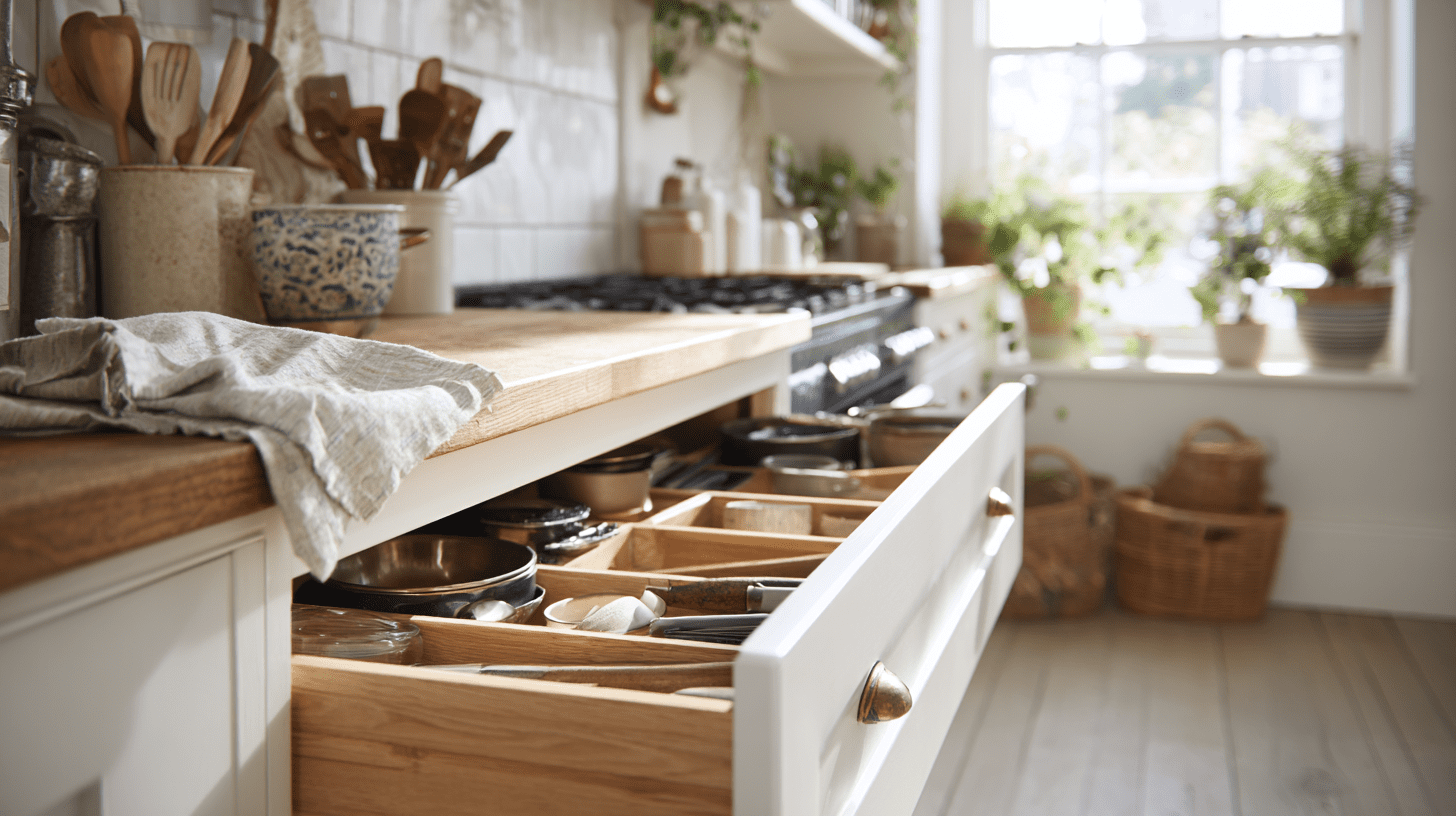
If you have deep kitchen drawers and they currently look like a crime scene every time you open them, you’re in exactly the right place.
I have a kitchen in South East London that was designed by someone who clearly loved the idea of deep drawers in theory. Three of them. Lovely in principle. In practice, for the first two years after we moved in, they were basically a place where things went to be forgotten. The bottom of each one was a mystery. Lids without pots. Pots without lids. A mandoline I genuinely thought we’d lost. Half a bag of rice that had escaped its clip.
So this post is for you if you have deep kitchen drawers that currently aren’t working, if you’ve tried to sort them before and they’ve descended back into chaos within a fortnight, or if you just moved into a place with deep drawers and you want to set them up properly from the start.
This is not for you if your drawers are standard depth and you’re looking for a basic utensil tidy. That’s a different problem with different solutions. Deep drawers (typically anything over 20cm deep) have their own specific challenges, and the advice for shallow drawers doesn’t really translate.
What’s different about this post compared to most of the ones out there? Most of the top results are American, which means they’ll recommend The Container Store (not available here), reference products you can’t easily buy in the UK, and skip the nuances that come with British kitchen layouts and the brands we actually have access to. I’ve also been living with this system for over a year across three deep drawers in a busy family kitchen, so what I’m sharing has genuinely been tested.
Right then. Let’s get into it.
Why Deep Kitchen Drawers Are So Hard to Keep Organised
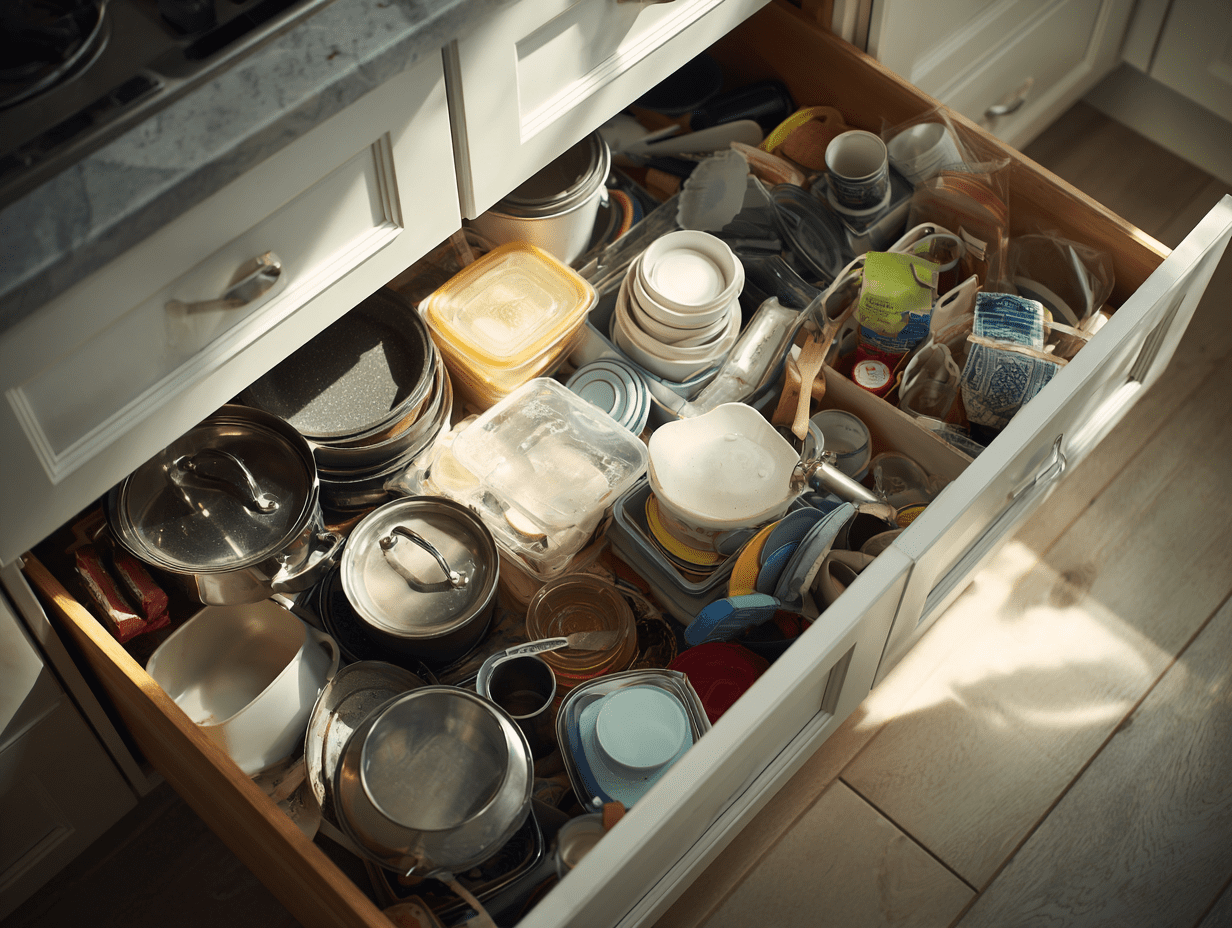
The problem with deep drawers isn’t that people are disorganised. It’s that deep drawers are genuinely counterintuitive to use well.
With a shallow drawer, everything sits in a single layer and you can see it all. With a deep drawer, you’ve got this lovely extra capacity and the temptation is to just keep putting things in. Things get buried. Things get stacked in ways that aren’t stable. You open the drawer, root around, shove things back, close it quickly, and within a week it’s a disaster.
The other issue is that most drawer organisation advice treats all drawers the same. It says: take everything out, group by category, put dividers in, done. That works fine for a standard cutlery drawer. For a deep drawer, it doesn’t get close to addressing the actual problem, which is how to use the vertical space meaningfully.
The vertical space is the whole point of a deep drawer. If you don’t actively plan for it, the drawer will use it for you, and not in a way you’ll enjoy.
Step One: Empty Everything Out Completely
This is non-negotiable, even though nobody enjoys doing it. You cannot plan the organisation of a deep drawer by peering into it. You need to see everything that’s in there laid out in front of you.
Pull everything out onto the counter or kitchen table, then wipe the drawer clean. A quick spray of kitchen cleaner and a dry cloth and you’re done. While you’re at it, measure the drawer. Width, depth, and height. Write these down. You will need them when you buy inserts.
Now sort what came out of the drawer into rough categories. You’re not deciding what goes back in yet. You’re just establishing what you actually have. In my case, this process revealed an astonishing number of lids, three potato mashers (we only need one), and an ice cream scoop still in its packaging. We’ve lived here for four years.
This is also the moment to be honest about what you don’t use. If something hasn’t come out of that drawer in six months, it’s either in the wrong drawer or it doesn’t need to live in a drawer at all. Charity shop pile or bin.
Step Two: Decide What the Drawer Is Actually For
This sounds obvious but it’s the step most people skip, and it’s the reason most organisation attempts don’t stick.
Before you buy a single insert or divider, you need to decide what this drawer’s job is. Each deep drawer should have one primary purpose. Not a general storage drawer. Not a “things that don’t fit elsewhere” drawer. A specific role.
In my kitchen, the three deep drawers are organised like this:
Drawer one is the pots and pans drawer. This is a very common use for deep drawers and it works brilliantly once it’s set up correctly. All the saucepans, the frying pan, and the lids live here. Nothing else.
Drawer two is what I call the cooking tools drawer. Silicone spatulas, wooden spoons, ladles, a couple of whisks, the grater. Things used during cooking rather than at the table.
Drawer three is a food storage drawer. Tupperware boxes, glass containers, and their lids. This was the most chaotic drawer and took the most planning to sort, but it’s now the most satisfying to open.
The key principle is that each drawer should serve one clear purpose, even if that category is reasonably broad. The moment you start adding overflow from other categories, the whole system begins to fail.
Step Three: Choose the Right Inserts for Each Drawer Type
This is where the specifics really matter, because the solution for a pots and pans drawer is completely different to the solution for a food storage drawer.
For pots, pans, and lids
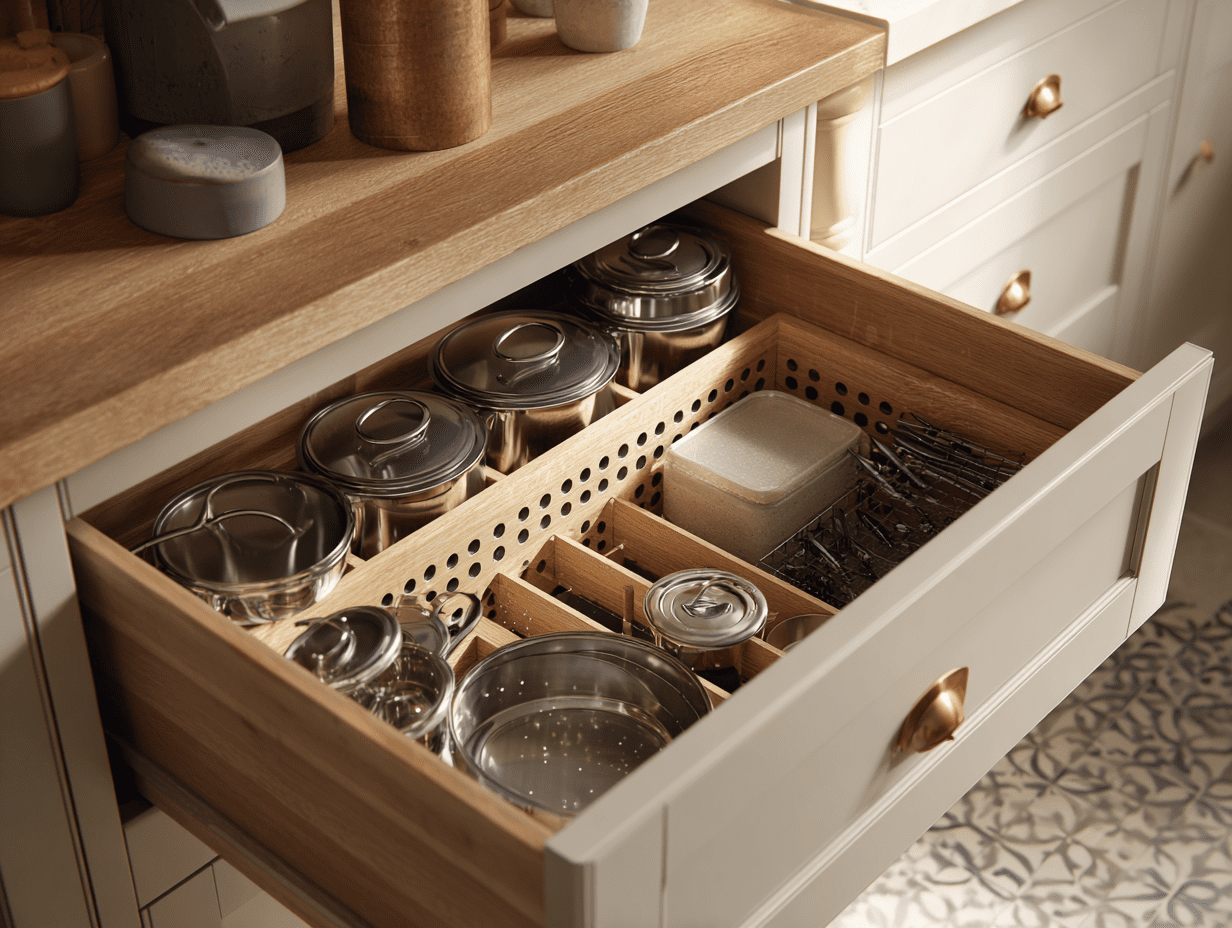
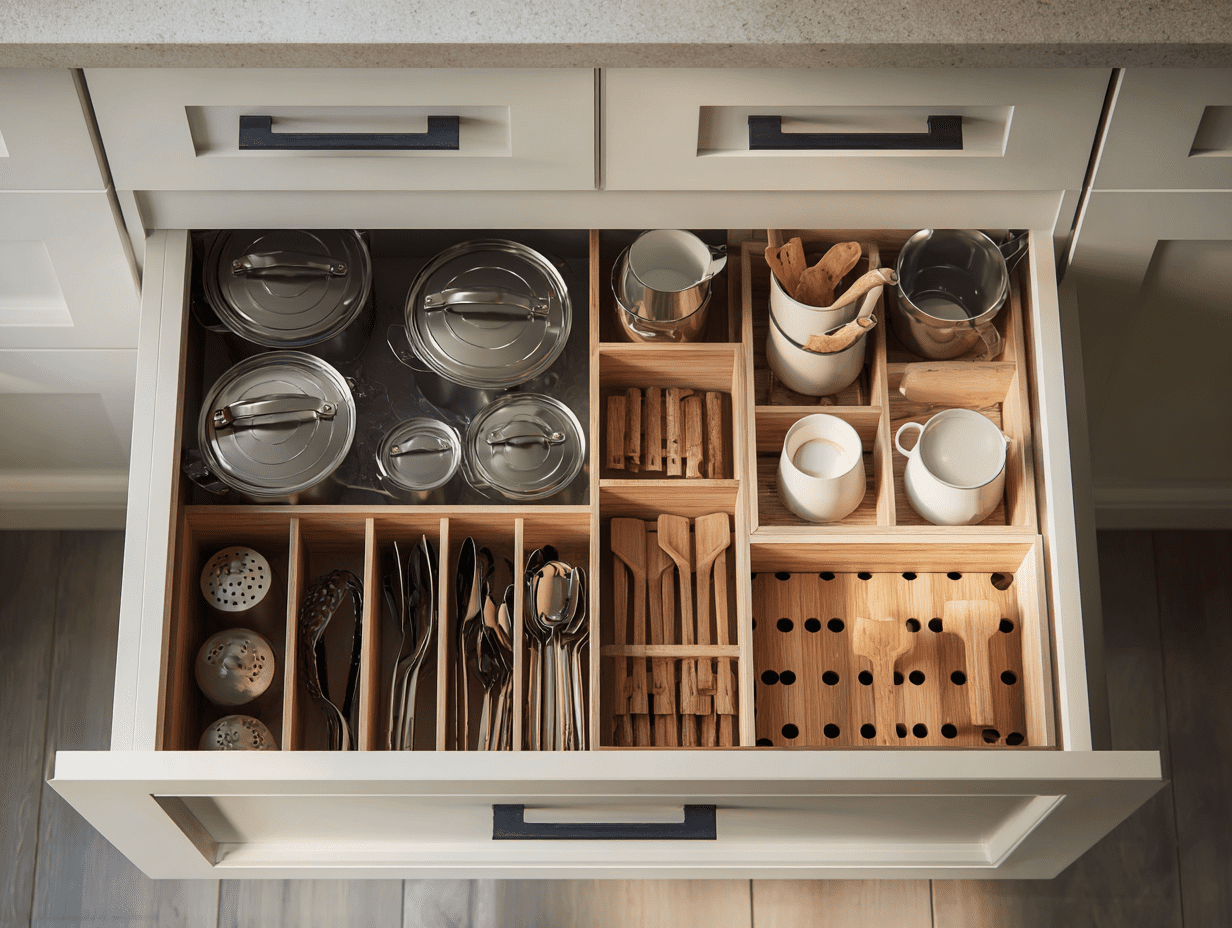
The best solution for a deep drawer full of cookware is a pegboard system. These are drawer inserts where you can move pegs around to create custom compartments for different sized pots and pans. IKEA’s UPPDATERA range includes pegboard inserts that work well in standard-sized drawers and are reasonably priced. The Joseph Joseph DrawerStore range is also worth looking at and is available through Amazon UK, John Lewis, and Lakeland.
The key thing with pots and pans is to store lids separately from the pots. Lids nested on top of pots in a deep drawer cause chaos. Stand the lids upright using a vertical divider or a small rack, and keep the pots flat in their sections. This single change will make the drawer feel manageable.
Avoid stacking pots more than two high unless they nest very neatly. The leaning tower problem is real and deeply irritating when you’re trying to cook dinner.
For cooking utensils
Adjustable bamboo dividers are brilliant here. They expand to fit your drawer width and you can create sections of different sizes. Available on Amazon UK, at Dunelm, and often in Wilko. Measure your drawer width first and make sure the dividers you buy will expand far enough.
For a deep utensil drawer specifically, consider using a taller container for your longest tools such as wooden spoons and silicone spatulas, and shorter sections for smaller items like a garlic press or peeler. You’re essentially creating a vertical and horizontal system within the same drawer.
For food storage containers
This is the hardest type of drawer to organise and maintain. The problem is that containers and lids never seem to match up and sizes vary so much that one category system often fails.
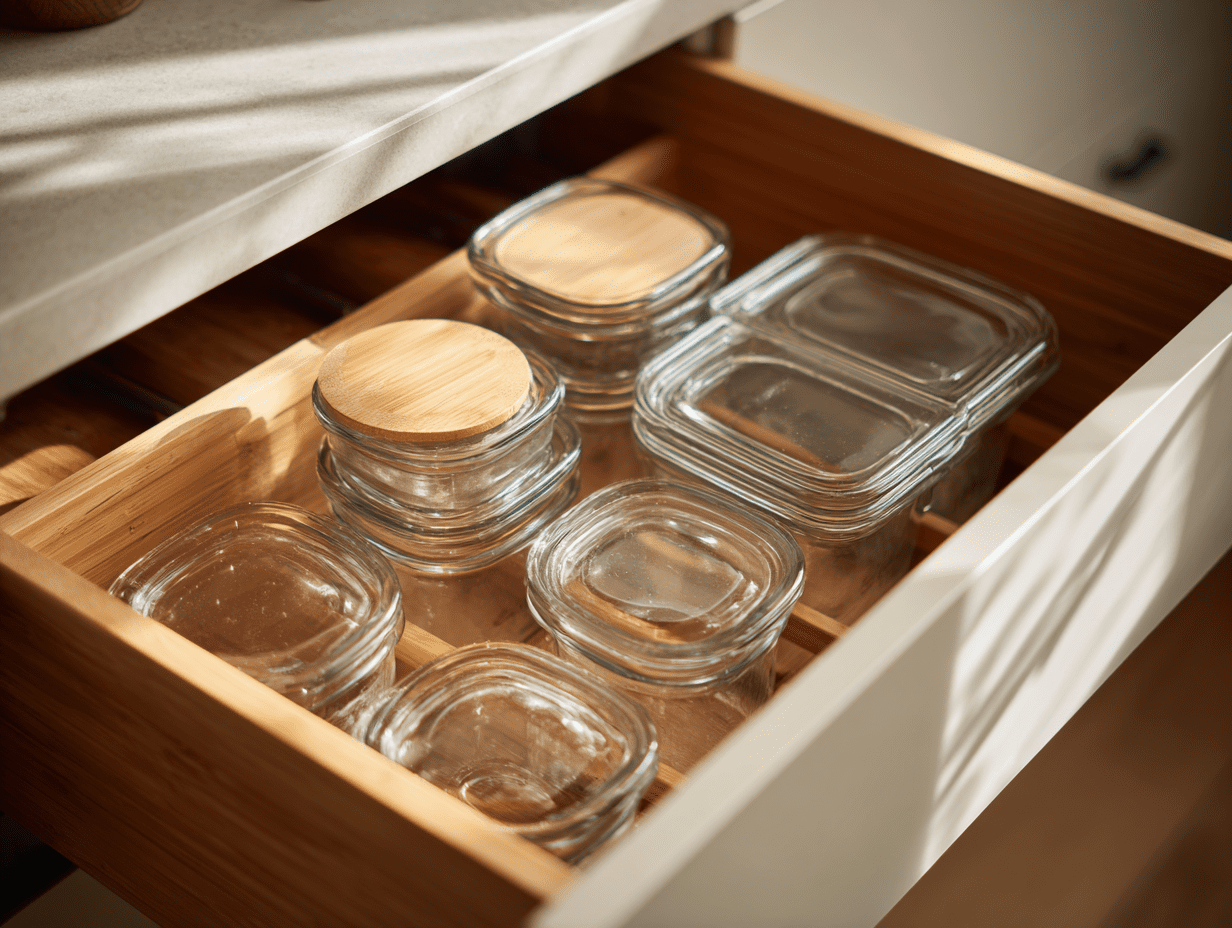
The approach that has worked best for me is to ditch the idea of storing containers with their lids and instead create a dedicated lid zone. Lids go into a small vertical file-style holder (search “lid organiser” on Amazon UK or check the IKEA kitchen section). Containers are then nested by size in the rest of the drawer. Once your brain adjusts to this system, it’s genuinely fast to use.
If you prefer to keep lids with their containers, store each container with its lid on and closed, and stack like-sized containers. This takes up more space but is visually easier to navigate.
| Solution | Best For | Where to Buy in UK | Approx. Cost |
|---|---|---|---|
| Pegboard insert | Pots and pans | IKEA, Amazon UK | £15 to £35 |
| Adjustable bamboo dividers | Utensils, mixed tools | Dunelm, Amazon UK, Wilko | £10 to £20 |
| Vertical lid rack | Food storage lids | Amazon UK, IKEA | £8 to £15 |
| Stackable clear inserts | Small items, spice jars | Amazon UK, Lakeland | £12 to £25 |
| Acrylic drawer organiser set | Utensils, general storage | Amazon UK, Paperchase | £15 to £30 |
The table above is a quick guide to the most practical UK options. It’s worth buying from somewhere with a decent returns policy the first time, because the fit matters more than the product itself.
Step Four: Use the Vertical Space Deliberately
This is the part that separates a deep drawer that works from one that looks organised for a week and then collapses.
In a standard drawer, you think in two dimensions: width and depth. In a deep drawer, you have a third dimension available, and that’s height. You need to use it deliberately.
Stacking inserts are one option. These are two-tier systems where a top tray slides out or lifts to reveal a lower section. They’re genuinely useful for a drawer that needs to hold two categories of items. A good example would be baking tools in the upper tier (used regularly) and specialist gadgets in the lower tier (used occasionally). OXO make a good version available through Amazon UK.
Containers of different heights work in a similar way. If you’re using your deep drawer for dry goods or decanted snacks, a mix of tall and short containers creates layers of accessibility. Tall containers for things like pasta, shorter ones for nuts or dried fruit.
One practical thing worth saying: don’t feel obliged to use all the depth of the drawer just because it’s there. If your system works and leaves a few centimetres spare at the top, that’s fine. An over-filled drawer will always be harder to maintain than one with a bit of breathing room.
Step Five: Label and Maintain
Everyone says label everything, and yes, for deep drawers it genuinely matters. The bottom of a deep drawer is harder to see into than a shallow one, and labelling the zones means anyone putting things away (including you after a long day) knows where things go.
You don’t need a label maker, though if you love one, go for it. A small strip of masking tape and a permanent marker on the front edge of an insert or container is enough.
Maintenance is simpler than people think once the system is set up. The rule I follow is that anything without a clear home in the drawer doesn’t go in the drawer. If something lands in there without a place, that’s the signal to review the system, not to shove it in and hope for the best.
A quick five-minute sort every few weeks is all it takes. Open the drawer, check that everything is roughly where it should be, move anything that’s crept out of zone, and close it again. Done.
Common Mistakes People Make with Deep Kitchen Drawers
It’s worth running through the things that most commonly cause deep drawer organisation to fail, because I’ve made several of these myself.
Buying organisers before measuring. This is the classic mistake. You see a lovely bamboo divider set, you buy it, it doesn’t fit. Always measure first: width, height, and depth.
Using the same system as a shallow drawer. A single-layer divider in a deep drawer leaves most of the height unused and you’ll fill that dead space with things that then fall over. Think layers.
Storing lids with pots in a disorganised pile. As above, separate them. The lid situation is almost always the reason a cookware drawer looks terrible.
Overcrowding. A deep drawer has generous capacity but that doesn’t mean you should use all of it. Leave room to grab things easily. If you have to wrestle something out, the drawer is too full.
Not deciding what the drawer is for. If a drawer doesn’t have a clear purpose, it becomes a dumping ground. Decide what goes in it, and everything else goes elsewhere.
FAQs: Organising Deep Kitchen Drawers
What is the best way to organise a deep kitchen drawer? The most effective approach is to give each deep drawer one clear purpose, such as pots and pans, cooking utensils, or food storage containers, and then choose inserts that use the full height of the drawer rather than just the base. Pegboard systems work brilliantly for cookware, while adjustable bamboo dividers suit utensil drawers. Avoid mixing categories and always measure before buying inserts.
How do I stop deep drawers becoming messy again? The main reason deep drawers descend back into chaos is that items don’t have clearly defined zones. Once everything has a specific spot and can be returned to it easily, maintenance is minimal. A quick five-minute weekly check is usually all it takes. If the drawer keeps getting messy in the same spot, that’s a sign the system for that zone needs tweaking rather than the whole drawer redoing.
What can I store in deep kitchen drawers? Deep kitchen drawers are ideal for pots and pans (with lids stored separately), food storage containers, baking tools, cooking utensils, and decanted dry goods in tall containers. They’re less well-suited to cutlery or small everyday items that are better in a shallower drawer where everything stays visible.
Are pegboard drawer inserts worth it? For a cookware drawer, yes, absolutely. Pegboard inserts let you create custom-sized compartments for different pots and pans, which means nothing slides or tips. They’re more expensive than basic dividers but far more functional for bulky items. IKEA’s UPPDATERA range and various Amazon UK options are both worth looking at.
Can I organise a deep drawer without buying anything? You can get a significant improvement just by decluttering, grouping items properly, and storing lids vertically using something you already own, like a clean cooling rack or a small magazine file. Buying the right insert does make a lasting difference, but you don’t need to spend a lot. Dunelm and Amazon UK both have good budget options under £15.
What’s the difference between a deep drawer and a standard kitchen drawer? Standard kitchen drawers are typically around 10 to 15cm deep, which is enough for cutlery and utensils in a single layer. Deep drawers are usually 20cm or more in depth, designed to hold bulkier items like pots, pans, and food containers. The extra height requires a different organisational approach that accounts for the vertical space rather than treating it like a bigger version of a shallow drawer.
Conclusion
Organising deep kitchen drawers is one of those tasks that feels like it should be straightforward but has a habit of going wrong because the standard advice doesn’t quite account for all that extra height.
The short version: decide what each drawer is for before you buy a single insert, use products that account for the full depth of the drawer rather than just the base, and keep each drawer to one primary purpose. Do those three things and you’ll find your deep drawers go from being the most frustrating part of your kitchen to genuinely one of the most functional.
My biggest personal tip? Sort the lids situation first. It’s almost always the lids.
If you have deep kitchen drawers that are driving you absolutely mad right now, start with one. Empty it, decide its purpose, measure it, and go from there. An hour of focused effort will make a difference you’ll notice every single day!
See more home organisation posts here!

Becky is the voice behind Life in Velvet, an organised, intentional living blog focused on practical food, calm homes, thoughtful projects, and everyday systems that make real life feel easier. A mum of 3 living in the UK, Becky writes from lived experience, sharing what works, what doesn’t, and the decisions that make family life run more smoothly.
With a background in marketing and content writing, and over a decade of blogging experience, she brings a thoughtful, structured approach to everything from baking and home projects to routines and decision-making. Life in Velvet is where planning meets creativity, with ideas designed for real homes and real life.