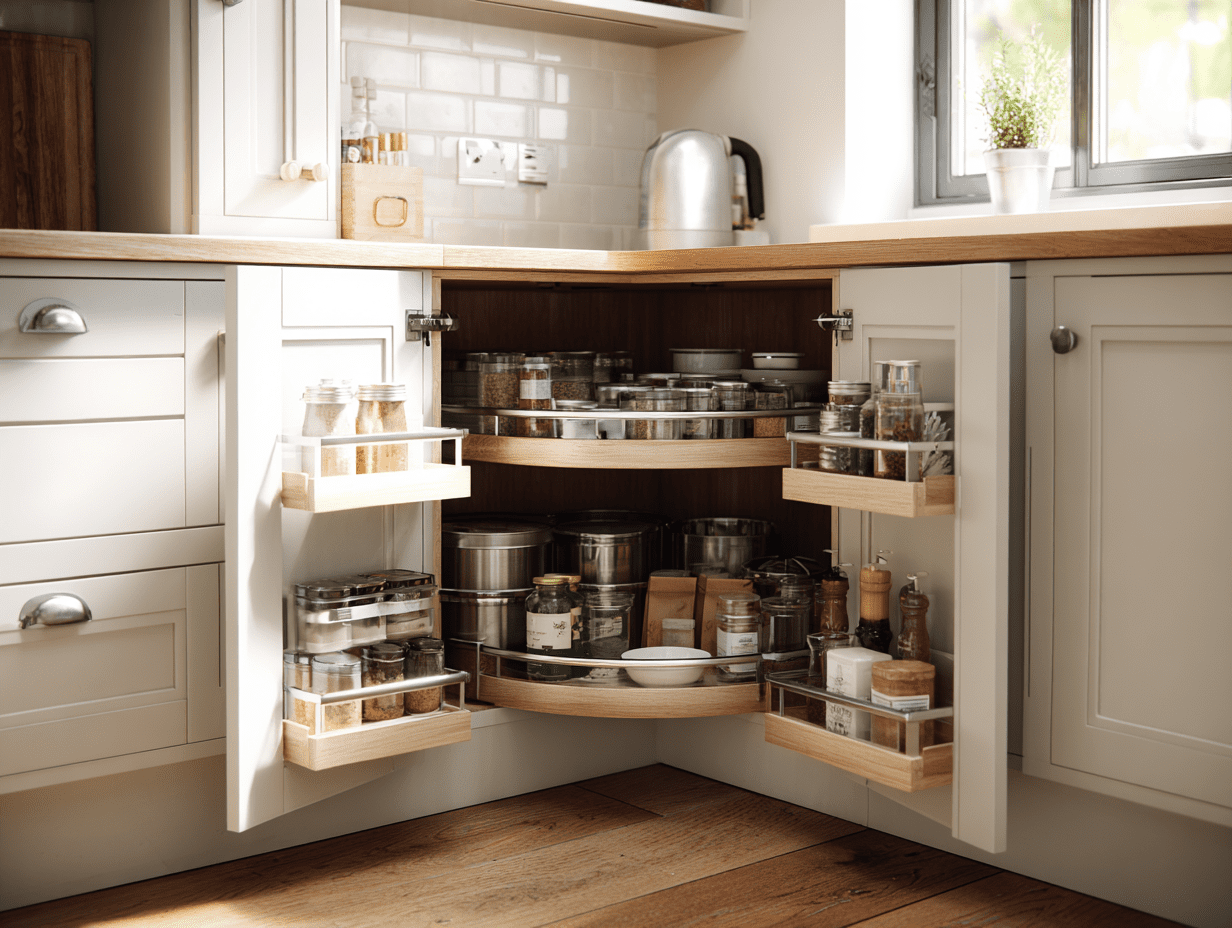
I’ve had two lazy Susan cabinets across two different kitchens, and I’ve made every single mistake you can make with both of them. So if you’ve ended up here because yours has quietly become the most chaotic spot in your kitchen, I completely understand. The short answer is: the best things to keep in a lazy Susan cabinet are tinned goods, baking supplies, and spices – stable, medium-sized items you use regularly but not every day. But there’s quite a bit more to it than that, because the real problem with most lazy Susans isn’t what’s in them. It’s that nobody teaches you how they actually work.
Most of the content out there on this topic is either American (so the brands and shops are useless to us) or it’s just a list of pretty pictures that doesn’t explain why the thing jams, why stuff keeps toppling off the back, or why you keep forgetting what’s in there and buying duplicates. This post tries to fix that.

Why corner lazy Susans go wrong
It’s not the cabinet’s fault, honestly. The problem is that most people treat a lazy Susan like a regular cupboard and just fill it up with whatever needs a home. Tins get stacked at odd angles. Bottles tip over and jam the mechanism mid-spin. Small packets slide off the curved edge and end up wedged behind the shelves where they will never be found again. Within a few months the whole thing is a write-off and you’re opening that door as rarely as possible.
The specific design of a corner lazy Susan makes it genuinely different from a standard shelf. The shelves are curved – usually kidney-shaped or full circles – and they rotate around a central pole. The depth is much greater than a regular cabinet, which means anything not right at the front can completely disappear into the back of the dark corner. And unlike a pull-out drawer where you can see everything at once, you have to spin the lazy Susan to find things, which means if your system breaks down even slightly, the whole thing becomes unusable very quickly.
The other thing nobody mentions is that the access point is slightly awkward. You’re reaching into a corner, usually at a slight angle, which means anything heavy, breakable, or that you need to grab quickly five times a day is genuinely not ideal in there. That’s not a design flaw so much as just reality – and knowing that upfront saves a lot of frustration.
What actually belongs in there
Once I understood what the lazy Susan is and isn’t suited to, the whole thing clicked. The sweet spot is items that tick these three boxes: you use them regularly but not constantly, they’re stable enough not to topple when the shelf spins, and they’re not so small that they’ll slide off the curved edge.
Tinned goods are genuinely the lazy Susan’s best friend. Tins of chopped tomatoes, coconut milk, chickpeas, lentils – they’re heavy enough to stay put, uniform enough to stack, and used regularly enough that you actually want to be able to find them. I group mine by type across the lower shelf and it works brilliantly. Reaching in for a tin of tomatoes takes about three seconds now.
Baking supplies are another good fit – flour, sugar, bicarbonate of soda, baking powder, dried fruit, vanilla extract. These are the things you need when you need them but don’t reach for every day, and having them all in one rotating shelf means you’re not rummaging through multiple cupboards every time you want to make a cake with the kids.
Spices and dried herbs are the classic answer, and they do work well – particularly if you’ve got a standalone turntable sitting inside an upper cabinet rather than a built-in corner unit. The rotating action means nothing disappears to the back, which is pretty much the whole point.
Cleaning products under the sink is a use I’d never thought about until I tried it, and it’s one of my favourites. Dishwasher tablets, washing-up liquid refills, spare sponges, scouring pads – all spinning neatly on a turntable inside the under-sink cabinet instead of falling over behind the pipe.
Things that really don’t work (and I wish someone had told me)
Tall, thin bottles are a disaster. Olive oil, wine vinegar, soy sauce – anything tall and slender will tip over mid-spin, potentially knock other things with it, and at worst jam the whole mechanism so the shelf won’t rotate at all. Either keep them somewhere else or, if you really want oils in there, lay them on their sides in a small tray.
Anything very small and loose is also a problem. Loose teabags, individual spice sachets, small seed packets – they migrate off the curved edge of the shelf, fall down behind, and become completely inaccessible. If you want small things in a lazy Susan they need to be in a container first.
Daily-use items are a bad choice too, and this one surprised me. I used to keep my everyday pans in the corner cabinet thinking it made sense, and I was wrong. Reaching into a corner at a slight angle to grab a heavy pan several times a day is annoying. It doesn’t sound like a big deal but the cumulative irritation is real. Anything you reach for every single day – the kettle, the toaster, your daily pans, your mugs – should live somewhere with straight-forward, easy access.
Breakable things are worth thinking about too. The rotating motion combined with the curved shelf means there’s more chance of things shifting or knocking together than on a standard flat shelf. I wouldn’t put good glassware or anything easily chipped in a built-in corner lazy Susan.
| Works well | Worth avoiding |
| Tinned goods – stable, stackable, medium-sized | Tall thin bottles – tip mid-spin, jam the mechanism |
| Baking supplies – regular use, not daily | Loose small items – slide off the curved edge |
| Spices and dried herbs – nothing disappears to the back | Daily-use pans – awkward corner access gets old quickly |
| Cleaning products under the sink | Breakable glassware – too much movement risk |
| Small appliances used occasionally | Open bags or boxes – they fall and spill in there |
The pattern here is pretty consistent: stable, medium-sized, regular-but-not-constant. Everything else belongs somewhere else.
The wedge bin thing – genuinely not optional
If you only take one thing from this post, take this. Wedge-shaped bins are completely transformative for a corner lazy Susan, and most people never find out they exist because they’re not widely stocked in UK shops and nobody talks about them.
The problem with trying to organise a curved shelf is that all standard storage containers are rectangular. They don’t fit the shape of the shelf properly, so you end up with wasted space at the edges and things shifting around. Wedge bins – sometimes called pie-shaped bins or sector organisers – are shaped to fit the curve. They sit flush against each other, fill the shelf properly, and each one becomes a dedicated zone for a category of items.
You can find them on Amazon UK – search ‘lazy Susan wedge bins‘ or ‘pie shaped cabinet organiser’. A set of three (which covers one shelf tier) costs around 15 to 25 pounds depending on brand. Clear ones are worth the slightly higher price because you can see what’s inside without spinning. Look for ones with a small raised lip or non-slip base if you can find them.
The one thing to get right before you buy is measuring. You need the diameter of your shelf – the distance from one edge to the other across the middle – and the depth from the central pole to the outer edge. Most standard UK corner base unit lazy Susans are around 80 to 90 centimetres in diameter, but measure yours before ordering because getting the wrong size is annoying.

How I’d actually sort one out from scratch
Take everything out first. All of it, onto the worktop or kitchen table. Don’t try to edit as you go – you need to see the full scale of what’s been living in there, including the things that have been quietly expiring at the back for the past eighteen months.
While the shelves are empty, wipe them down. Corner cabinets get greasy in a way that’s very easy to ignore when there’s always stuff in the way. Warm water and washing-up liquid, five minutes, done.
Then do a proper edit before anything goes back. Check every date, be honest about what you actually use, and ask yourself whether each item genuinely belongs in a corner cabinet or whether it ended up there because you didn’t know what else to do with it. That second category can go somewhere else or get thrown out entirely.
Group what’s left by category on the worktop before you start putting things back. This is the bit most people skip, and it makes a massive difference. You need to know how much space each category needs before you decide on your layout.
Then put the most-used things on the outer edge of each shelf tier, with less-used things further back. If you’ve got two tiers, heavier items (tins) tend to work better on the lower shelf. Lighter things (baking supplies, spices) sit fine on the upper.
Leave some space. This is probably the most counterintuitive bit. A lazy Susan that’s three-quarters full works much better than one that’s rammed. Things can spin freely, you can see what’s there, and items are less likely to knock each other over. Resist the urge to fill every inch.
Where to actually buy organiser bits in the UK
This is where most posts fail British readers – they recommend American stores that don’t ship here or suggest brands that cost twice as much once you add international shipping. Here’s what’s actually available.
Amazon UK is the most practical option for wedge bins specifically. The selection is decent, delivery is quick, and the prices are reasonable. Search ‘lazy Susan wedge organiser’ or ‘pie shaped bin’ for the best results.
Lakeland sometimes carries standalone lazy Susan turntables and pantry organisers. Worth checking their site if you prefer to buy from a proper UK homewares shop rather than Amazon.
For a non-slip shelf liner (genuinely worth doing before you put anything back), Dunelm, Wilko, and most pound shops sell grip liner by the metre for almost nothing.
If you’ve got a standard corner cabinet without a built-in lazy Susan and you want to retrofit one, B&Q and Screwfix both stock corner cabinet carousel inserts. It’s more of a project – you’ll need to measure carefully and probably remove the existing shelf – but it’s absolutely achievable as a weekend DIY job if you’re reasonably handy.

A few things nobody mentions
The mechanism does need occasional cleaning. The pole and the rotating shelf contact points collect grease and grime over time, and a sticky lazy Susan is a frustrating one. When you do a big reorganise, take a damp cloth with some multi-purpose cleaner to the central pole and the shelf edges. It takes two minutes and makes a noticeable difference to how smoothly it spins.
Laying tins on their sides is a genuine game-changer if you keep having them tip over. Tins are much more stable horizontal than vertical on a curved shelf, and you can fit more of them too. A small tray or bin to keep them in place helps even more.
The lazy Susan isn’t just for the kitchen. I have a standalone turntable under the bathroom sink for cleaning products, one on a craft shelf for pens and scissors, and one on a pantry shelf for condiments and sauces. Once you get the hang of how useful the rotating format is, you start seeing opportunities everywhere. The under-sink bathroom one in particular – genuinely one of the most useful organisational changes I’ve made. Things that used to disappear behind the pipework now spin forward in about half a second.

Is it worth replacing a lazy Susan with drawers instead?
This comes up a lot and I’ve thought about it, so it seems worth addressing. Pull-out drawer systems for corner cabinets have become much more popular in recent years – you’ll see them in a lot of new-build kitchens and kitchen renovation posts. And they do look very satisfying.
But the honest answer is that for most people, properly organising the existing lazy Susan will give you more storage than replacing it with drawers. The pie-shaped shelves of a corner lazy Susan hold more volume than most pull-out alternatives because they use the full depth of the corner. Drawers by their nature can’t access all of that space.
The exception is if your lazy Susan mechanism is actually broken, makes grinding noises, or won’t spin properly even when it’s not overloaded. At that point, repair or replacement is worth considering. A broken mechanism that you’ve been working around for two years is genuinely not a problem you have to put up with.
For most people though, the issue isn’t structural. It’s just a containment and organisation problem. Sort those two things out first before spending several hundred pounds on a new corner unit.

Questions people usually have
What’s the best thing to put in a lazy Susan cabinet?
Tinned goods, baking supplies, and spices are the classic answer, and they genuinely work well. The common thread is items that are stable (won’t topple when the shelf spins), medium-sized (not tiny enough to slide off the curved edge), and used regularly enough that you want easy access to them but not so constantly that a corner location is a pain. Cleaning products under the sink are another great use that most people don’t think of.
Why does my lazy Susan keep jamming?
The most common cause is something that’s fallen off a shelf and got wedged between the rotating shelf and the cabinet frame or door. Pull everything out, have a proper look inside, and clear any debris before you do anything else. After that, look at what you’re storing – tall thin bottles, overloaded shelves, and items placed too close to the outer edge are the usual culprits. A wedge bin system usually fixes this for good because it stops things sliding around in the first place.
Can I add a lazy Susan to a corner cabinet that doesn’t already have one?
Yes, you can retrofit a carousel insert into most standard corner base units. B&Q and Screwfix both stock them. You’ll need to measure your cabinet carefully – specifically the internal width and the door opening – and you may need to remove an existing fixed shelf. It’s a manageable DIY job for most people but if your cabinet is an unusual shape or size, it’s worth getting a kitchen fitter to take a look first rather than ordering something that won’t fit.
Where can I buy wedge bins for a lazy Susan in the UK?
Amazon UK is the most practical option – search ‘lazy Susan wedge bins’ or ‘pie shaped cabinet organiser’. You’re looking for a set that fits your shelf diameter (measure first – most UK corner unit lazy Susans are 80 to 90 centimetres across). Expect to pay around 15 to 25 pounds for a set of three, which covers one shelf tier. They’re not widely available in UK high street shops, which is why most people never find out they exist.
How often should I reorganise a lazy Susan?
A full reorganise once or twice a year is enough if you maintain it as you go. What actually keeps it working well is a quick five-minute spin-and-check every few weeks – pull anything that’s migrated to the back, check a few dates, wipe any spills. That’s honestly all it takes. The cabinets that turn into black holes are usually the ones that never get any attention between the big annual clear-outs.
A lazy Susan cabinet gets a worse reputation than it deserves, mostly because people treat it like a standard cupboard and wonder why it doesn’t work like one. Once you understand what it’s actually good at and sort out the containment problem with a few wedge bins and a bit of shelf liner, it genuinely becomes one of the most useful spots in the kitchen.
Mine used to be the one cupboard I actively avoided opening. Now it’s satisfying to use. The whole thing took about an hour and cost around twenty pounds. If yours is currently a source of low-level kitchen stress, it’s worth giving it a proper hour of attention. The fix is almost always simpler than it feels.
See more home organisation and storage post ideas here

Becky is the voice behind Life in Velvet, an organised, intentional living blog focused on practical food, calm homes, thoughtful projects, and everyday systems that make real life feel easier. A mum of 3 living in the UK, Becky writes from lived experience, sharing what works, what doesn’t, and the decisions that make family life run more smoothly.
With a background in marketing and content writing, and over a decade of blogging experience, she brings a thoughtful, structured approach to everything from baking and home projects to routines and decision-making. Life in Velvet is where planning meets creativity, with ideas designed for real homes and real life.