
If your food storage containers are a problem, you already know it. You open the cupboard, something falls out, you spend three minutes hunting for a lid that matches absolutely nothing, and you end up just putting cling film over the bowl instead. The good news is that organising food storage containers isn’t complicated – the basic fix is to stop storing lids with their containers, cut your collection down to what you genuinely use, and give everything a dedicated spot. That’s really it. The rest is just working out what that looks like in your specific kitchen.
I’ve been through about four different systems over the years. Some lasted a week. One lasted about four years and counting. Here’s everything I’ve worked out, including the things that nobody else seems to mention.
The first thing to do isn’t buy anything
This is where most people go wrong. They see a satisfying before-and-after on Instagram, order a set of acrylic lid organisers, and then wonder why the whole thing falls apart within a fortnight. The organising comes after the edit. Always.
Pull everything out. Yes, everything. The giant container you’ve had since 2019 and never used. The three lids without a partner. The containers that have gone vaguely orange from a bolognese incident at some point in the distant past. All of it, out on the worktop.
Now go through it. For every container, find its lid. If it doesn’t have a matching lid, get rid of it. If the lid doesn’t seal properly, get rid of it. If it’s stained, warped, or you genuinely can’t remember what you use it for, get rid of it. Donate if they’re in decent nick, recycle if not – most plastic food containers can go in your household recycling but check your local council’s guidance, as it varies quite a bit across different London boroughs and beyond.
What you’re left with should be a streamlined set of containers and lids that you’d actually use. Which brings me to the question nobody ever seems to answer properly:
How many food storage containers do you actually need?
The honest answer is: far fewer than you probably have.
A useful rough guide is to think about your biggest single use case. For most families, that’s leftovers from dinner. If you cook for four and tend to have two or three portions left over on a weeknight, you need maybe four or five containers in a medium size. Add a couple of larger ones for things like soup or batch-cooked rice, and a few small ones for things like half an avocado or a wedge of lemon. That’s your core set – maybe ten to twelve containers in total.
If you batch cook on Sundays, you might need a few more. If you use containers for packed lunches, those tend to be a separate category (more on that in a moment). But a family of four almost certainly doesn’t need thirty-seven containers in eleven different sizes, which is what most of us seem to end up with.
Being honest about this number before you start organising makes everything easier. You’re not trying to shoehorn a massive collection into a small space – you’re curating what you actually need and finding a proper home for it.

The one rule that actually works: separate the lids
This is the bit that transforms the whole system and it sounds almost too simple. Don’t store lids on their containers. Store all the containers nested together, and store all the lids separately.
When containers have their lids on, they can’t nest properly – they topple, they don’t stack, and the whole thing is a mess every time someone opens the door. When you separate them, the containers nest down neatly by size and shape, and the lids can go in a basket, a lid organiser, or even just stood upright in a small bin.
The key is to sort the lids by shape rather than trying to match them to individual containers. Round lids in one section, rectangular in another. That way, even if you’re reaching in half-asleep on a Tuesday morning, you know roughly where to look.
Where to actually keep them in a small kitchen
If you’ve got one of those kitchens where storage is genuinely at a premium – which, let’s be honest, describes most South London homes – the location question matters a lot.
A low, deep cabinet near the dishwasher or sink tends to work best for empty containers, because that’s where you’ll be putting them away. If you’ve got a pull-out shelf in there, brilliant. If you haven’t, a couple of inexpensive wire shelf risers from IKEA or Lakeland will double your usable height without spending much at all.
If you’ve got a kitchen drawer deep enough to fit your containers standing upright, that’s worth considering too. A drawer gives you a clear view of everything at once and tends to stay more organised because there’s less opportunity for things to topple. Some people use adjustable bamboo dividers in there, which look good and don’t cost a fortune – B&M and Home Bargains both usually stock something suitable, and you’ll pay a fraction of what the same thing costs in a kitchen shop.
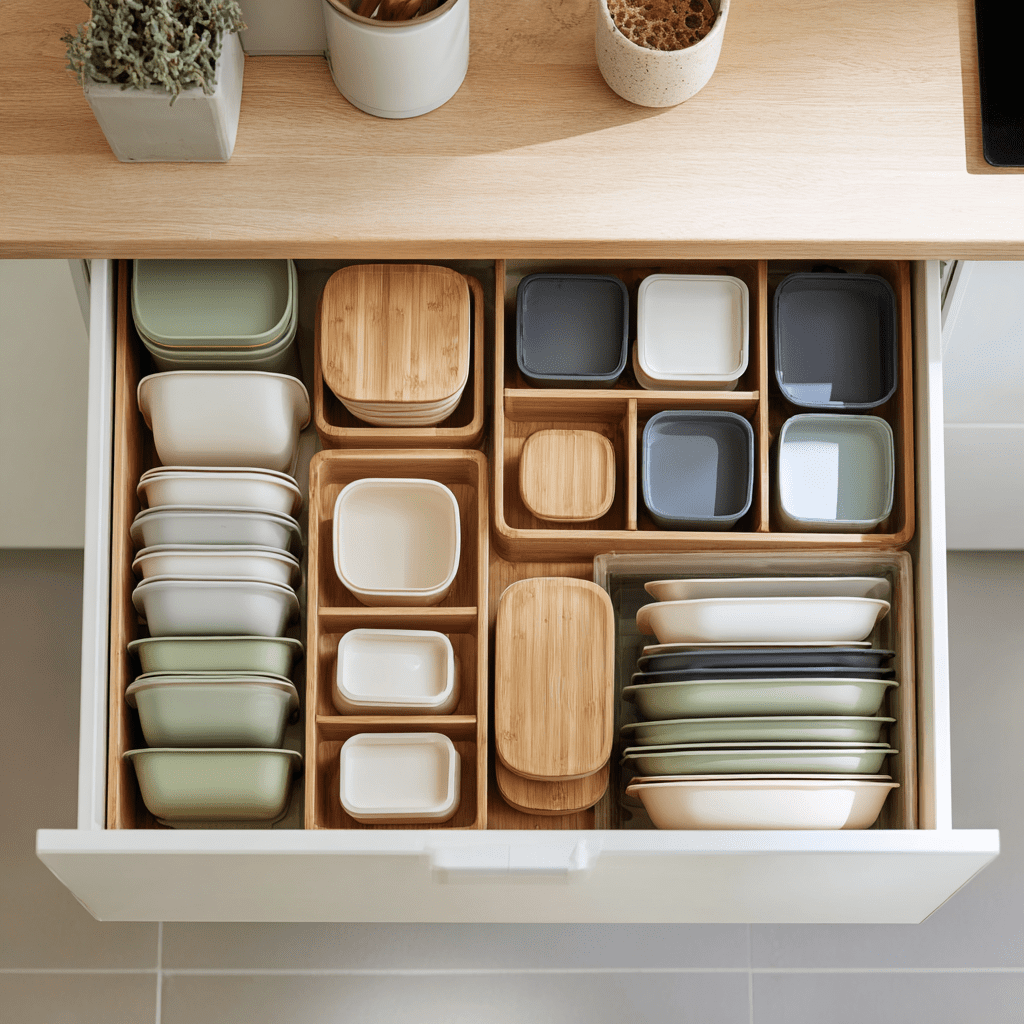
For the lids, a few options that genuinely work:
- A small basket or bin just for lids, stored next to the nested containers
- An over-door organiser on the inside of the cabinet door, particularly useful if you’re short on shelf space
- A dedicated section of a kitchen drawer, with lids stood upright
The over-door option is great in theory but does require the door to swing freely and the organiser to be shallow enough not to hit the shelves when you close it. Check your measurements before you commit. You might like to read my post on How to Organise Deep Kitchen Drawers for some organising inspo!
Glass versus plastic: a genuinely useful comparison
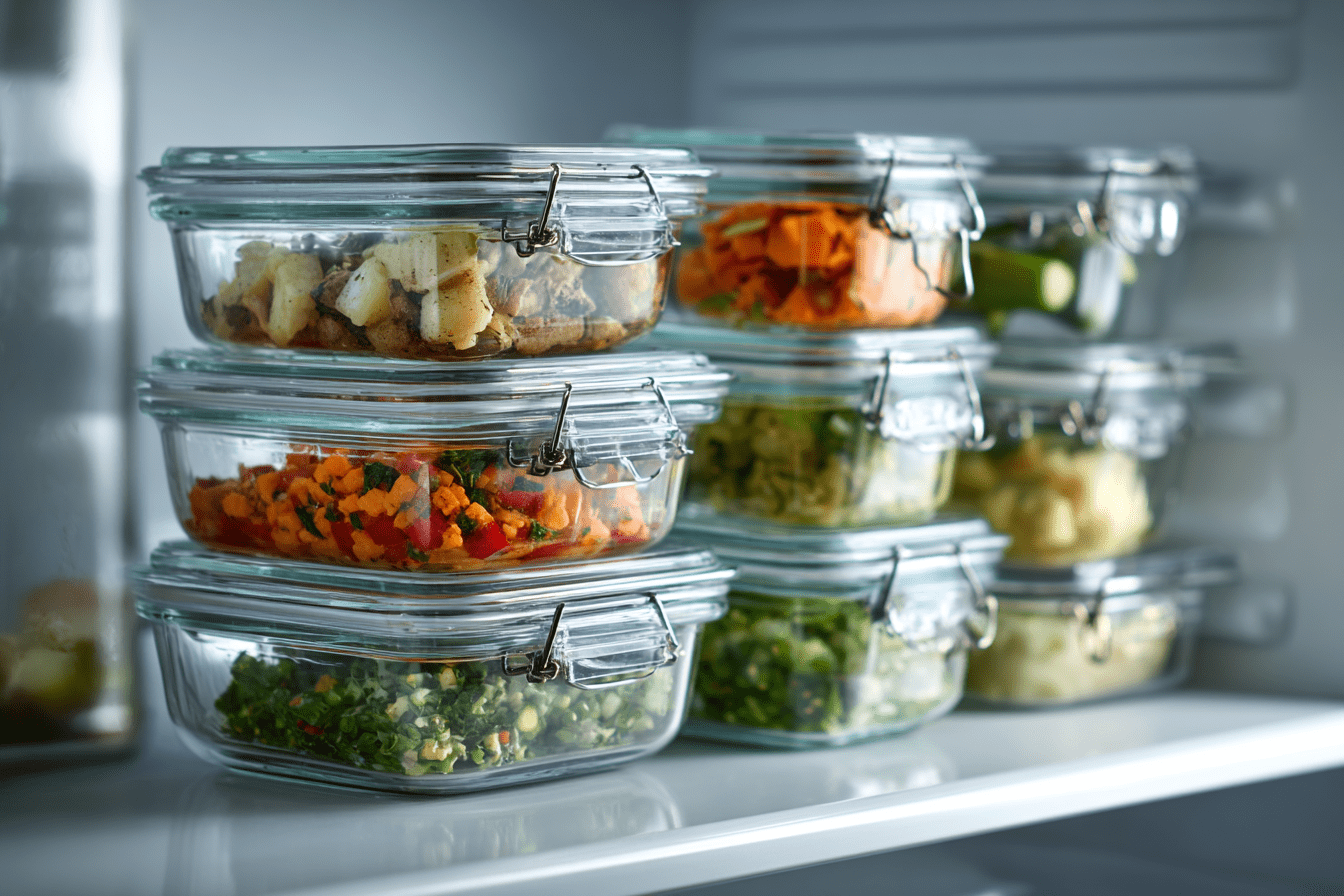
Most of the advice on this topic doesn’t get into the glass versus plastic question, and it’s worth spending a moment on it because the choice affects how you organise and store them.
Plastic containers are lighter, less likely to shatter if someone knocks them off a shelf (particularly relevant if you have children), and easier to find in matching sets that nest well. The downsides are that they stain, they can warp if you put them in a hot dishwasher, and over time the lids stop sealing as well. A decent set of plastic containers from Sistema, Clip & Close, or the Lock & Lock range tends to last a few years before you’re replacing parts.
Glass containers are heavier, obviously, but they don’t stain, they don’t absorb smells, and you can go straight from fridge to oven to dishwasher without any fuss. If you batch cook or meal prep regularly, glass is almost always the better choice because it handles temperature changes without any issues. Pyrex is the obvious brand here and you can pick up sets from John Lewis, Amazon, or IKEA. They’re more expensive upfront but they genuinely last.
The real problem with glass is storage space. Glass containers don’t nest as well as plastic because of the lids, and they’re heavier to pull in and out of a deep shelf. If you’ve got a small kitchen, mixing both tends to work well: glass for the fridge and oven-to-table containers, plastic for packed lunches and everyday leftovers.
School lunch containers are a different category
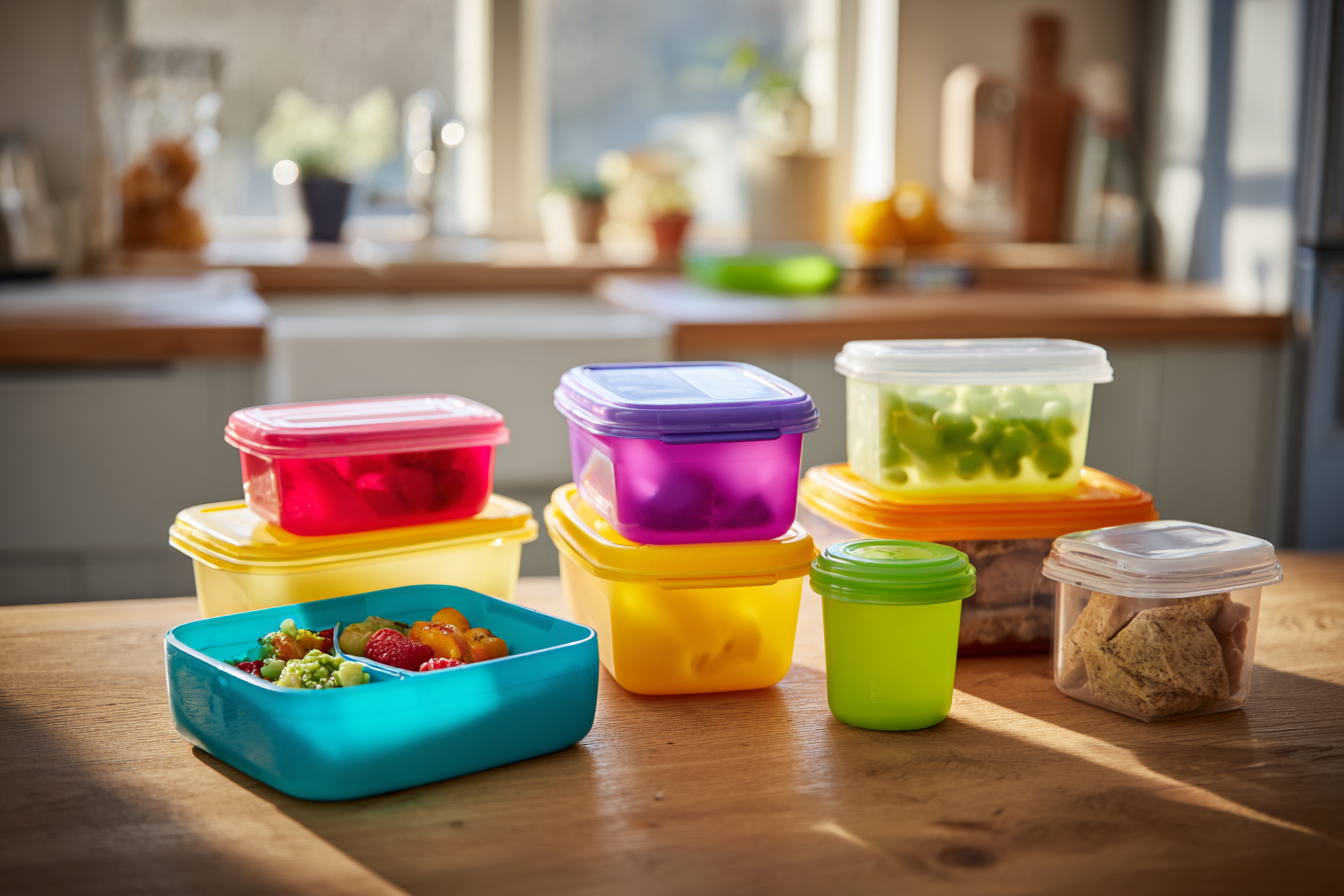
This is something I’ve never seen mentioned in any post about container organisation, but if you’ve got children it matters. Lunch box containers have completely different requirements from your general food storage set. They’re smaller, they need proper leak-proof lids, they might be branded (my youngest has a very specific opinion about what her snack pot looks like), and they get used every single day.
Keep school lunch containers completely separate from your general food storage system. A small basket on a low shelf, a dedicated drawer section, or even just a corner of a specific cupboard works fine. The point is that when you’re packing lunches at 7:30am you don’t want to be digging through the leftover-soup containers to find the right size pot for grapes.
If you send packed lunches regularly, it’s worth having slightly more than you need for one day — two or three sets means you’re not doing emergency container washing every evening, and you’ve got a backup when something inevitably gets left at school.
The honest truth about getting your household to maintain the system
Here’s the bit nobody says: if you’re the only person in your house who cares about the container situation, your system needs to be idiot-proof. Not because your family is incapable, but because they’re not thinking about it the way you are.
The systems that survive in real family kitchens are the ones that require minimal decision-making. One basket for lids, containers nested together, done. The moment your system requires someone to remember which size lid goes in which section of a divider, or to match things up before putting them away, it’ll be chaos again within a week.
So when you’re setting things up, ask yourself: if someone else in the house was putting these away, without any instructions, would they be able to figure it out? If the answer is yes, you’ve got a good system. If the answer is no, simplify it until it is.
A few things nobody else mentions
Some smaller observations that have genuinely made a difference:
If you batch buy good quality containers, try to stick to one or two brands from the same range. Mixing brands means the sizes don’t align, the lids don’t nest properly, and it’s harder to keep things orderly. It’s more of an upfront cost, but a single coherent set lasts longer and stays tidier.
If you’ve got deep cabinets where things get lost at the back, a turntable (lazy Susan) is genuinely useful. It costs very little, takes up minimal space, and means you can spin it to reach things at the back rather than pulling everything out to find what you need.
Label your lids if you’ve got multiple similar sizes. A small dot of coloured sticker or a label maker mark on the underside of each lid (colour-coded to the container) sounds excessive until you’re standing there on a Sunday night trying to work out whether the lid in your hand fits the soup container or the pasta pot.
And finally, do a quick audit every few months. Not a big reorganise, just a five-minute check. Pull everything out, check for missing lids, anything that’s warped or stained, and anything you’re just not using. Keeping the collection tightly edited is what stops it from creeping back into chaos.

FAQs
How do I stop food storage container lids going missing?
The most effective approach is storing lids in a fixed, specific place every time rather than matching them to their containers. If lids always live in the same basket or section of a drawer, there’s nowhere for them to disappear to. The other common culprit is containers being returned to the cupboard without their lids, which then go into a random spot. A household rule of “lids always go in the lid basket” is more effective than trying to keep them matched up.
Is it better to store food containers with lids on or off?
Off, generally. Storing containers without their lids allows them to nest properly, which saves significant space and keeps things stable. The lids go in a separate basket or organiser sorted by shape. The exception is very small containers, which can be stored with their lids on inside a single small bin without causing problems.
What’s the best type of container organiser to use in a kitchen cupboard?
It depends on what you’ve got to work with. In a standard cupboard, a combination of a small basket for lids plus nested containers works well and costs almost nothing. If you’ve got a deep cupboard, pull-out shelf risers or a turntable help you access things at the back. If you’ve got a kitchen drawer, adjustable dividers or a purpose-made lid organiser are worth it. Avoid buying elaborate multi-section systems until you know exactly how many containers you’re keeping — the spec of the organiser needs to match your actual collection.
How many food storage containers does a family of four need?
Realistically, ten to fifteen covers most situations. That’s a few large containers for batch cooking and soup, a handful of medium ones for standard leftovers, and a few small ones for things like half a lemon or leftover sauce. Packed lunch containers are separate and depend on how many children you’re packing for and how often. The number most families actually have is much higher, which is usually the problem.
What should I do with food storage containers that have no lids?
Get rid of them. Lidless containers are clutter — they can’t do the job they’re meant to do, they take up space, and they add to the visual noise of the cupboard. If they’re in good condition, charity shops occasionally take them if they’re part of a set. Otherwise, check your local council’s guidance on plastic recycling. There’s no version of a system where orphan containers improve things.
See more home organisation posts here

Becky is the voice behind Life in Velvet, an organised, intentional living blog focused on practical food, calm homes, thoughtful projects, and everyday systems that make real life feel easier. A mum of 3 living in the UK, Becky writes from lived experience, sharing what works, what doesn’t, and the decisions that make family life run more smoothly.
With a background in marketing and content writing, and over a decade of blogging experience, she brings a thoughtful, structured approach to everything from baking and home projects to routines and decision-making. Life in Velvet is where planning meets creativity, with ideas designed for real homes and real life.