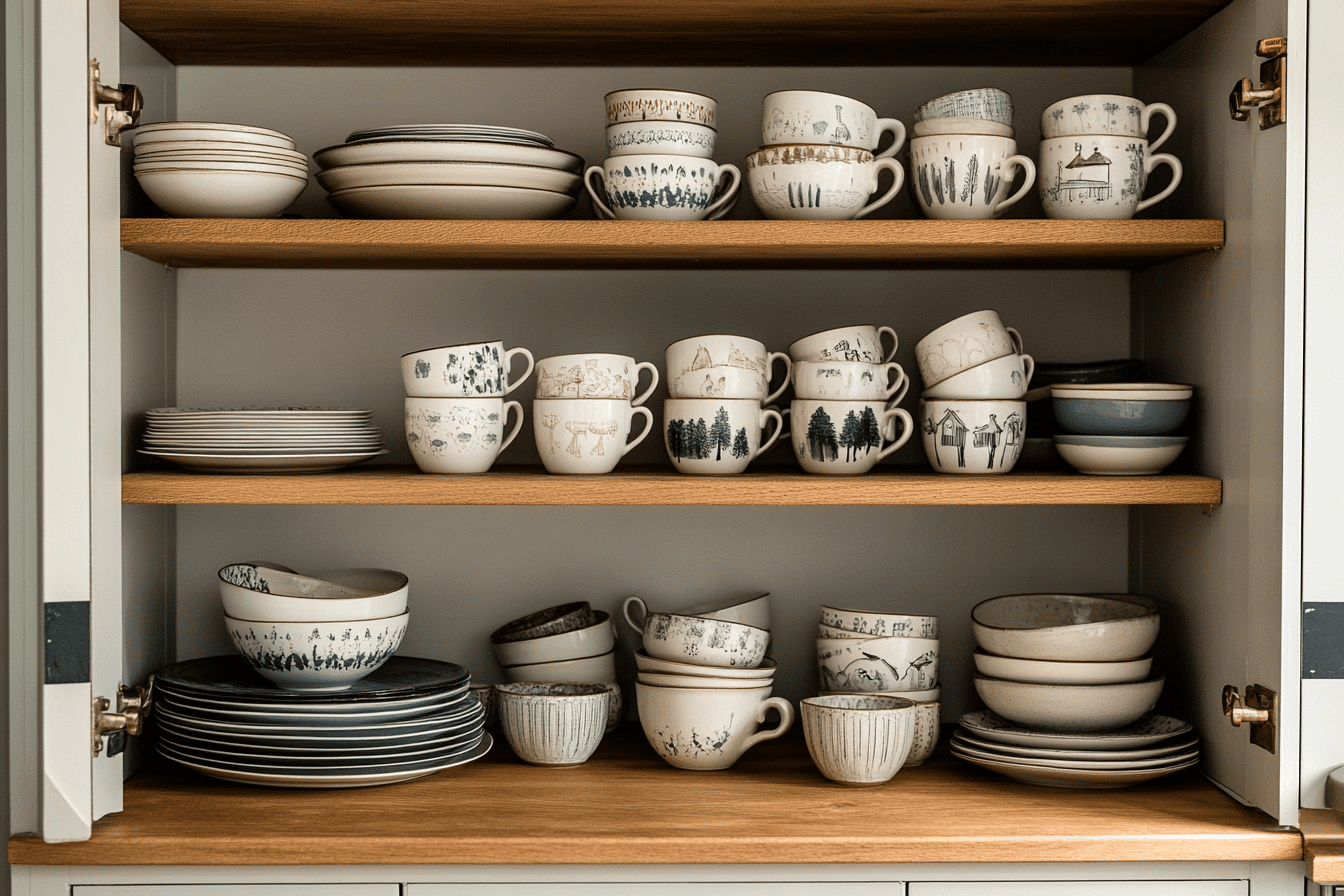
The most effective way to organise kitchen cupboards is to sort by zone before you buy a single basket. Group everything by how your household actually uses the kitchen, assign each category a fixed home, then fit out the storage around that logic. Do it the other way round and you’ll be reorganising again in six weeks.
I know this because I’ve done it the wrong way twice. Once when we first moved into our London house and I went straight to Dunelm with a trolley and optimism, and once when my youngest was about three and the entire lower half of the kitchen had been claimed by toddler snack pouches and plastic cups. Both times I bought the products first and tried to make the logic fit around them. Both times it lasted about a fortnight before entropy took over and the good intentions ended up stacked on top of each other in the corner cupboard.
The third time, I did it properly. That system has now survived three kids, a global pandemic, one complete kitchen reorganisation when we got the worktops replaced, and approximately 40,000 after-school snack raids. This is what actually works.
Why kitchen cupboard systems keep collapsing
It’s almost never the products. The bamboo drawer dividers are fine. The stackable tins are fine. The over-door rack is fine. The problem is that most cupboard organisation advice treats the kitchen as a static space where things live in neat categories, rather than a high-traffic environment where five different people are opening and closing doors at different hours for different reasons.
In a family kitchen, you need to account for the person making packed lunches at 7am in the dark, the teenager who can somehow locate the last packet of crisps from three rooms away, the eight-year-old who’s perfectly capable of getting their own snack but needs the snack to be at eight-year-old height, and the adult trying to cook a proper meal whilst all of the above is happening simultaneously. No amount of beautiful clear containers fixes this if the underlying logic doesn’t match how the kitchen gets used.
Zone-based organisation is the answer, and it’s simpler than it sounds.

Before anything else: the declutter
Empty the cupboards. All of them, ideally in one session, definitely before you buy anything. This is non-negotiable and I say this as someone who once tried to skip it and ended up building an elaborate organisation system around a bread maker I genuinely forgot I owned.
As you empty, sort into four piles: keep and use regularly, keep but use occasionally (the roasting tin, the fondue set you’ve had since 2009), donate or pass on, and bin. The “bin” pile is for anything broken, expired, or so profoundly useless that it can’t even be donated in good conscience.
Be honest about the occasional-use items. In a UK kitchen, storage is almost always more limited than you want it to be. Anything that gets used less than once a month can live in a higher cupboard, a garage shelf, or a box under the stairs. It does not need prime real estate in the main cooking area. We have a high shelf above the utility room door where the Christmas serving platters, the giant stockpot, and the cake tins live. Nobody needs them on a Tuesday morning.
Once everything’s out, wipe down the shelves. It’s satisfying and it gives you a moment to actually look at the space you’re working with before filling it back up.
Map the zones before you touch a shelf
Walk around your kitchen and think about what happens where. Cooking happens near the hob. Eating and serving happen nearer the table or the worktop where you plate up. Packed lunches get made near wherever you keep the bread. Drinks get poured near the sink.
A workable zone system for most UK family kitchens looks roughly like this:
Cook zone: Pots, pans, oils, spices, baking trays, utensils. Everything needed to actually prepare food lives here, near the hob and oven. This is the zone that benefits most from vertical storage inside cupboards, because you need to access things quickly and without having to unstack six items to reach the one you want.
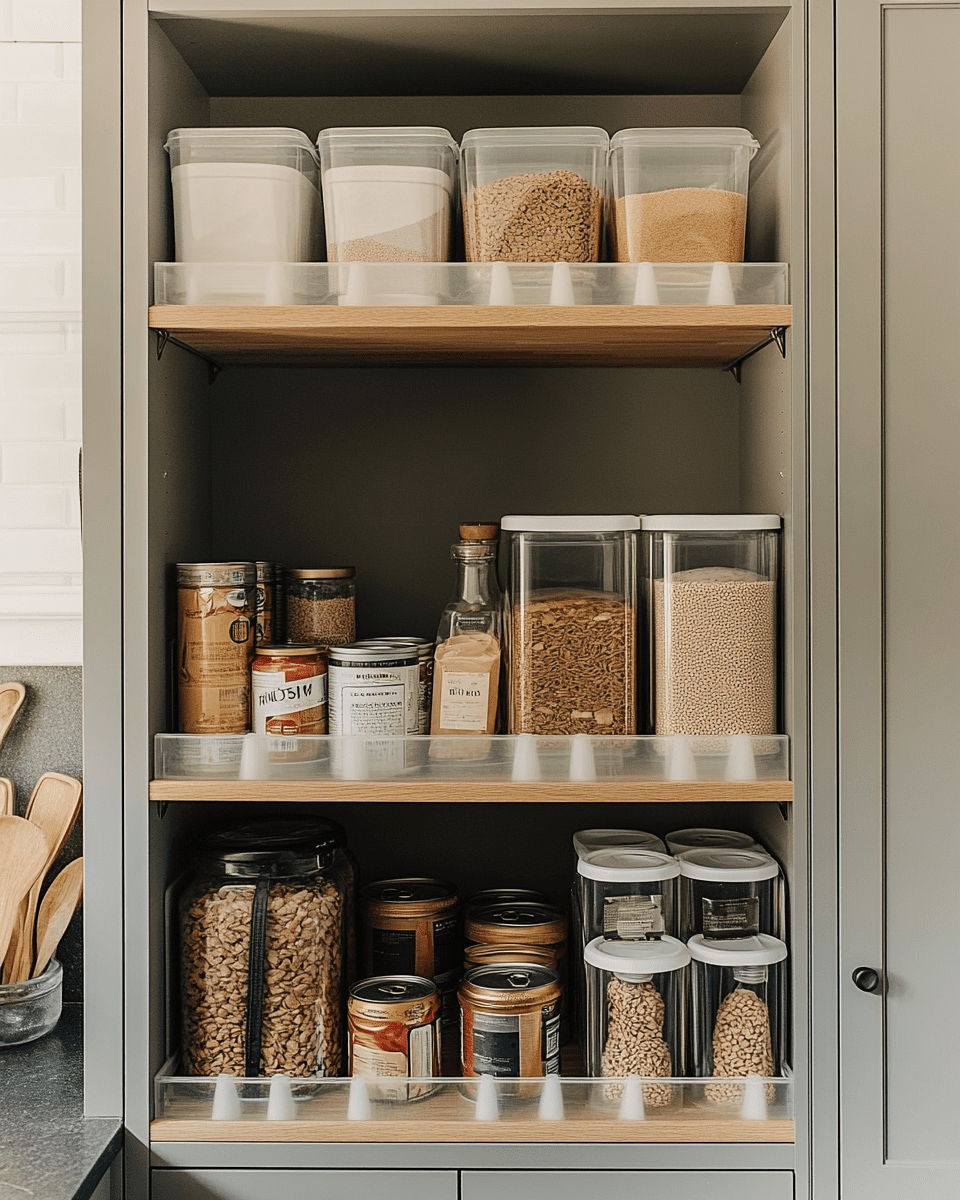
Food store zone: Tins, dried pasta, rice, pulses, cereals, jars of things. This doesn’t need to be near the hob, but it does need to be accessible and visible. The mistake here is deep shelving where things disappear to the back. More on that shortly.
Serve and eat zone: Plates, bowls, mugs, glasses, everyday cutlery. Ideally close to where you unload the dishwasher, because putting things away is the bit everyone avoids. If the plates have to travel the length of the kitchen to get back to their shelf, they’ll end up stacked on the nearest worktop instead.
Kids’ zone: This one gets missed in almost every guide I’ve read and it makes a significant practical difference. In our house, the lowest accessible cupboard is entirely the kids’ zone. Their cups, their snack boxes, their cereal bars, their individual water bottles. My eight-year-old can fully self-serve breakfast and after-school snacks without asking anyone for help, which is wonderful both for her and for me. The teenagers can, theoretically, reach anything in the kitchen, but they also have a designated shelf in the food store zone for their specific things, which stops them from raiding the dinner ingredients.
Cleaning and under-sink zone: Cleaning products, washing-up liquid, dishwasher tablets. These want to stay where they’re used, not mixed in with the food cupboards for obvious reasons.
Cupboard by cupboard: what goes where
Once you’ve got the zones mapped, placing things becomes much more straightforward. A few specific points that make a genuine difference in a typical UK kitchen:
The corner cupboard is where things go to die. If yours has standard fixed shelves, a lazy Susan is genuinely worth fitting. Alternatively, accept that corner cupboards are best used for bulky occasional-use items like the slow cooker or the stand mixer, so you’re not rooting around in them every day. Don’t waste a corner cupboard on everyday items unless you’re going to fit proper pull-out storage.
The food cupboard benefits enormously from decanting certain things into clear containers, but not everything needs to be decanted. Rice, pasta, lentils, and things you restock regularly are good candidates. Jars and tins with visible labels are fine as they are. Decanting everything into matching containers looks beautiful in photos and creates a significant amount of washing up every time you restock. Pick your battles.
What actually makes food cupboards function better is getting everything forward-facing and visible. Turntable organisers from Lakeland or IKEA’s VARIERA shelf inserts are good for this. Two-tier shelf risers, the kind available cheaply at Wilko or The Range, double your usable shelf space for tins and mean nothing gets lost at the back.
The pots and pans cupboard is the one most likely to make you want to close the door and pretend it doesn’t exist. Lid storage is the specific problem. A simple lid rack (vertical, sits inside the cupboard) takes up very little room and immediately transforms this cupboard from a game of Jenga into something manageable. Stack pans by size inside each other. Keep the ones you use daily at the front.
The spice situation deserves its own paragraph because it causes more domestic stress than it should. Deep shelves and small bottles are a terrible combination. A pull-out spice rack inside a cupboard door, a small drawer insert, or a two-tier turntable all solve this more effectively than any number of matching spice jars. I use a small lazy Susan inside a cupboard near the hob and it works well. Everything rotates to the front. Nothing gets lost. It also survives being used by a teenager who treats every cupboard like a lucky dip.
The products worth buying (from actual UK shops)
This is not a comprehensive product round-up. These are the specific things that have survived in our kitchen and are still in use more than a year after buying them.
Shelf risers from Wilko or The Range are genuinely useful and not expensive. Two tiers means twice the usable space in a standard-height cupboard. The wire ones are fine for tins. Bamboo ones look nicer but are heavier.
Clear stackable containers for dried goods. IKEA’s IKEA 365+ range works well and replaceable lids are important because lids always go missing eventually. Lakeland’s versions are slightly better quality. Avoid anything without a proper seal if you live somewhere humid.
Drawer organisers from Dunelm or IKEA. The bamboo expandable ones are the most useful because they fit actual UK drawer widths, which are not the same as the US drawers most Amazon product photos are sized for. Measure your drawers before buying anything.
A lazy Susan for corner cupboards or the food store zone. IKEA’s SNUDDA works, or the Lakeland version if you want something with a slightly better grip base. Not complicated, genuinely useful.
Over-door storage for the cupboard under the sink, which in most UK kitchens is an awkward shape with plumbing taking up a chunk of the space. A wire door rack doubles the storage without needing any drilling. The Command strip-based versions are good for rental properties.
Amazon UK also has a reasonable range of kitchen cupboard organisers worth browsing once you know what you’re looking for, particularly for specific sizes or formats you can’t find in-store locally.
What sounds good and doesn’t actually last
Matching sets of labelled storage for absolutely everything. They look brilliant on Instagram and require a level of restocking discipline that real family life doesn’t support. When you run out of something and put the new version in a slightly different container because the original is in the dishwasher, the system starts to crumble. Pick one or two areas where matching containers are worth the effort, like the main food store shelf. Leave the rest alone.
Hooks and rails on the inside of cupboard doors are excellent in theory. In practice, they add to the weight of the door and can cause soft-close hinges to stop closing properly over time, particularly in rental properties with cheaper cabinetry. Test carefully before committing to a full door’s worth.
Colour-coded container systems, especially with children. The eight-year-old respects the colour coding. The fifteen-year-old does not.

The reset that actually keeps the system working
The organisation isn’t the hardest part. Maintaining it is. A kitchen used by five people accumulates disorder faster than almost any other room in the house.
What works in our house is a ten-minute cupboard reset once a week, usually on a Sunday evening when I’m doing the food planning for the week ahead. It’s not a clean-out. It’s just: put things back where they belong, check the food cupboard for anything that needs using up or replacing, wipe down any shelves that need it. Ten minutes, done.
The system only stays functional if putting things back is easy. If it’s faster to chuck something in a rough direction and close the door than it is to put it in the correct place, that’s what will happen. This is why the zone logic matters so much before the products. When the logic is right, everything has an obvious home and returning things is effortless. When it’s not, even the most beautiful organisation system gets dismantled by entropy within a month.
A well-organised kitchen genuinely changes the daily texture of family life. Not in a dramatic way. But in the way that you can actually find the stock cubes, the after-school snacks are where they should be, and the Sunday meal prep doesn’t start with ten minutes of searching for the right pan. That’s the version worth building towards.
For anyone starting from scratch or dealing with a particularly chaotic kitchen, the Which? kitchen storage buying guide has useful independent advice on what to look for when comparing products across different price points.
Frequently asked questions
What’s the best way to organise a small kitchen with limited cupboard space?
Work vertically first. Shelf risers, stackable containers, and two-tier turntables all create more usable space within existing cupboards without any drilling or building work. Then audit what’s actually earning its place. In a small UK kitchen, anything used less than once a fortnight can usually move out of the kitchen entirely to free up space for everyday essentials.
How do I organise kitchen cupboards when I rent and can’t make changes?
Almost everything useful in kitchen cupboard organisation requires no drilling at all. Freestanding shelf risers, turntables, drawer organisers, and over-door racks that hang rather than screw are all renter-friendly. The exception is heavy over-door storage on lightweight doors, which can strain hinges over time. Command adhesive hooks work well for lightweight items inside cupboard doors without making permanent changes.
Where should I store pots and pans?
As close to the hob as possible. The nearer the cookware is to where you actually cook, the less unnecessary movement happens during meal preparation. If your nearest cupboard to the hob is an awkward shape, a vertical lid rack inside it and stacking pans by size make it significantly more functional without needing to rearrange the whole kitchen.
How do I keep kitchen cupboards organised with children?
Assign one low, accessible cupboard entirely to the children’s things: their cups, snack boxes, cereal, and whatever they’re allowed to help themselves to. When kids can self-serve without adult assistance, they’re much less likely to raid the wrong cupboard. Accept that any shared-use cupboard will experience some entropy and build a weekly reset into your routine rather than expecting it to stay perfect indefinitely.
Is it worth decanting food into matching containers?
For some things, yes. Rice, pasta, dried lentils, and cereals all benefit from clear containers because the originals bags are annoying to reseal and prone to spilling. For tins, jars, and anything with a short turnover, it’s usually not worth it. Partial decanting systems are harder to maintain than people expect, especially with multiple household members restocking at different times. Invest in containers where they genuinely earn their place, not across the board.
Liked this post? See some of my other home organisation posts!
How to Organise Under the Kitchen Sink (and Actually Keep It That Way)

Becky is the voice behind Life in Velvet, an organised, intentional living blog focused on practical food, calm homes, thoughtful projects, and everyday systems that make real life feel easier. A mum of 3 living in the UK, Becky writes from lived experience, sharing what works, what doesn’t, and the decisions that make family life run more smoothly.
With a background in marketing and content writing, and over a decade of blogging experience, she brings a thoughtful, structured approach to everything from baking and home projects to routines and decision-making. Life in Velvet is where planning meets creativity, with ideas designed for real homes and real life.